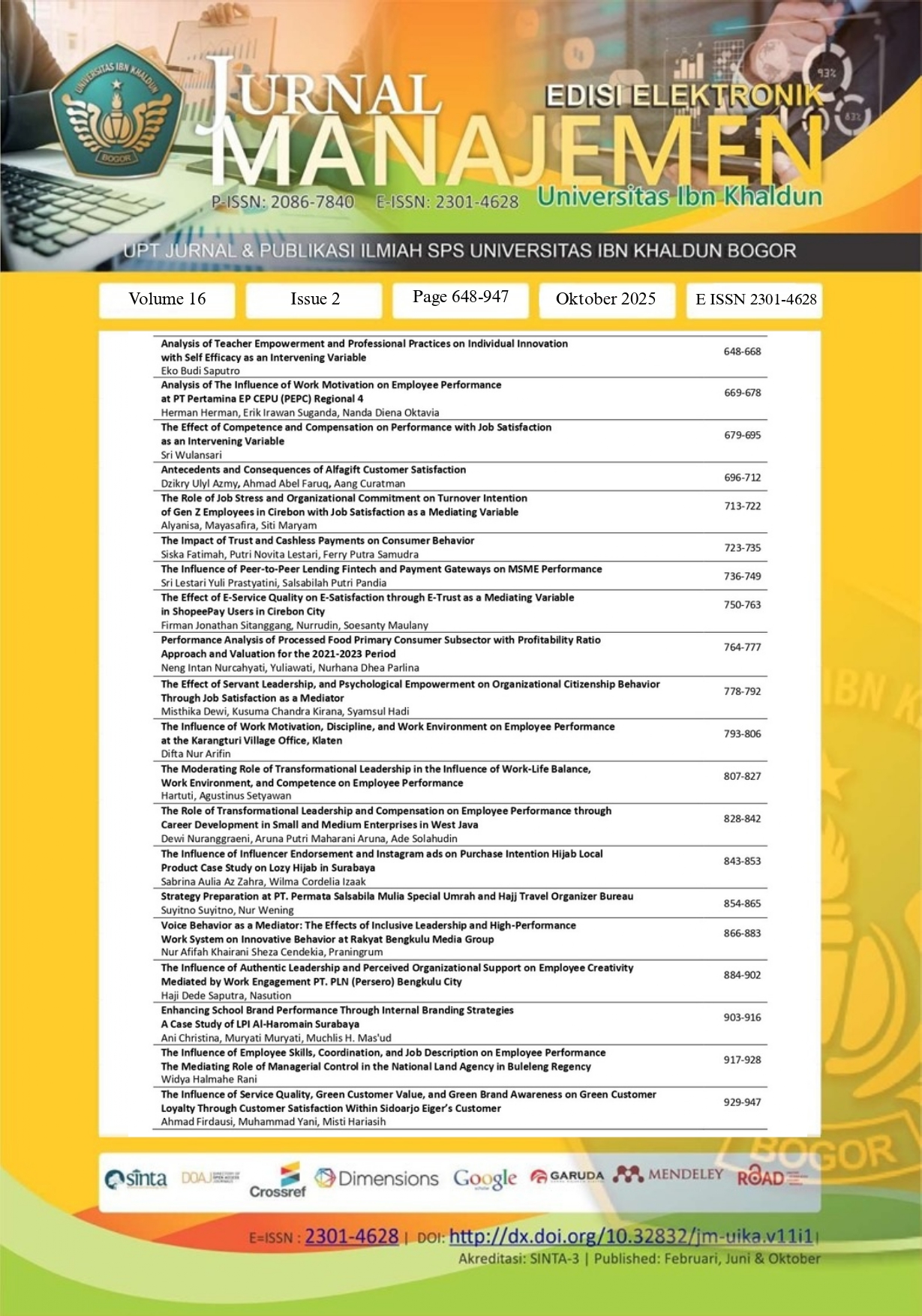
The Role of Job Stress and Organizational Commitment on Turnover Intention of Gen Z Employees in Cirebon with Job Satisfaction as a Mediating Variable
DOI:
https://doi.org/10.32832/jm-uika.v16i2.19691Keywords:
Work Stress, komitmen organisasi, Turnover Intention, Job SatisfactionAbstract
This research investigates the influence of work stress and organizational commitment on the turnover intention of Generation Z employees in Cirebon City, examining the mediating role of job satisfaction. Employing a quantitative approach with an associative design, data were collected via questionnaires from 253 Generation Z employees in Cirebon City and analyzed using Structural Equation Modeling (SEM) with SMART PLS. The findings indicate a positive and significant effect of work stress on turnover intention, while organizational commitment shows a negative but insignificant effect. Work stress has a negative and insignificant impact on job satisfaction, whereas organizational commitment positively and significantly influences job satisfaction. Furthermore, job satisfaction did not mediate the relationship between work stress and turnover intention; however, it did mediate the relationship between organizational commitment and turnover intention. These findings offer implications for organizations seeking to reduce turnover among Generation Z employees by addressing work stress and fostering organizational commitment, considering the role of job satisfaction. Future research could explore other antecedents of turnover intention, such as organizational culture, leadership styles, and career development opportunities. Comparative studies across different industries or regions could also enhance the understanding of this phenomenon.
References
Adinata, M. C., & Turangan, J. A. (2023). Pengaruh Motivasi Kerja, Stres Kerja, dan Lingkungan Kerja Terhadap Kepuasan Kerja Karyawan PT X. Jurnal Manajerial Dan Kewirausahaan, 5(01), 195–201. https://doi.org/10.34005/kinerja.v5i02.2726
Afandi, P. (2021). Manajemen Sumber Daya Manusia. Zanafa Publishing.
Aksa, N. D. A., & Transistari, R. (2021). Pengaruh Insentif Finansial, Motivasi, dan Stres Kerja terhadap Kepuasan Kerja Mitra Driver Go Ride. Cakrawangsa Bisnis, 2(1), 1–10.
Anastia, D., Adriani, Z., & Ratnawati, R. (2021). Pengaruh kepuasan kerja terhadap turnover intention pada karyawan sales PT. Dipo Internasional Pahala Otomotif Jambi. Jurnal Dinamika Manajemen, 9(2), 77–84.
Balqis, A., Yumna, A., & Setiawati, T. (2022). Pengaruh Pengembangan Karir dan Stress Kerja terhadap Turnover Intention melalui Kepuasan Kerja sebagai Variabel Intervening di Hotel Grand Inna Malioboro Yogyakarta. Selekta Manajemen: Jurnal Mahasiswa Bisnis & Manajemen, 01(05), 157–171.
Bogar, R., Sambul, S. A. P., & Rumawas, W. (2021). Pengaruh Beban Kerja dan Komitmen Organisasional terhadap Turnover Intention pada PT. Batavia Prosperindo Finance Tbk-Manado. Productivity, 2(4), 2021.
Carnegie, M. (2023). Are Gen Z the most stressed generation in the workplace? BBC News.
Desi, D. E., & Dosari, N. (2023). Pengaruh Komitmen Organisasional, Kompensasi dan Kepuasan Kerja Terhadap Turnover Intention Karyawan PT. BPR Kerinci. Jurnal Cahaya Mandalika, 754–762.
Hamid, S., & Fauzan, R. (2023). Pengaruh Stres Kerja, Komitmen Organisasi, dan Kepuasan Kerja Terhadap Turnover Intention (Studi Penelitian Hotel Gajahmada Pontianak). Management Business Innovation Conference, 6.
Harahap, D. H. (2023). Hubungan Komitmen Organisasi dan Kepuasan Kerja Karyawan di Universitas Proklamasi 45 Yogyakarta. Jurnal Psikologi, 19(2), 45–52.
Jobplanet. (2017). Tingkat Kesetiaan Karyawan dari Berbagai Generasi di Dunia Kerja. Jobplanet Official Blog.
Kumari, I. A. T. ., & Surya, I. . (2024). Pengaruh Kepuasan Kerja Terhadap Turnover Intentiondengan Komitmen Organisasional Sebagai mediasi. E-Jurnal Manajemen, 13(10), 1523–1437.
Kurniati, A., Dewi, D., & Simbolon, S. (2019). Pengaruh Stres Kerja dan Komitemen Organisasi Terhadap Turnover Intention Melalui Kepuasan Kerja Sebagai Variabel Mediasi Pada Karyawan PT. Indoil Energy.
Luthfurrahman, N., & Dahayu, A. (2024). Gen Z: Mengutamakan Kebahagiaan daripada Karier – Peluang dan Tantangan di Dunia Kerja. EQNews.
Ong, W., Sentoso, A., & Setyawan, A. (2023). Beban kerja, komitmen organisasi, dan turnover intention: Kepuasan kerja sebagai pemediasi. Jurnal Manajemen Maranatha, 23(1), 99–108. https://doi.org/10.28932/jmm.v23i1.7485
Pratiwi, F. (2022). Menaker: Gen Z tak Punya Komitmen Bekerja Jangka Panjang. Republika.
Priharti, D. veronica, & Marjati, R. (2022). Komitmen Organisasi dan Lingkungan Kerja Terhadap Kinerja Karyawan. Jurnal Manajemen Dan Perbankan (JUMPA), 9(3), 45–59. https://doi.org/10.55963/jumpa.v9i3.481
Robbins, S. P., & Judge, T. A. (2018). Perilaku Organisasi. Organizational Behavior (12th ed.). Salemba Empat.
Sandy, F., Riadi, S. S., Syaharuddin, Y., & Sutikno. (2023). Pengaruh Komitmen Organisasi dan Budaya Organisasi terhadap Kepuasan Kerja serta Kinerja Pegawai pada Dinas Pendidikan dan Kebudayaan Kota Samarinda. Jurnal Manajemen Tenaga Kependidikan (JMTK), 1(1), 11–20.
Solahudin, A., Fatimah, S. E., & Sulistiowati, L. H. (2024). Factors affecting affective commitment. Edelweiss Applied Science and Technology, 8(6), 3475–3483. https://doi.org/10.55214/25768484.v8i6.2738
Sugiyono. (2018). Metode Penelitian Kombinasi (Mixed Methods). CV Alfabeta.
Susijawati, N., Maryam, S., & S, L. H. (2017). Konflik peran ganda, disiplin dan komitmen organisasi terhadap kinerja perawat pada RSUD Gunung Jati Kota Cirebon. Jurnal Logika, 19(1), 69–72. http://jurnal.unswagati.ac.id
Susilo, J., & Satrya, I. G. B. H. (2019). Pengaruh Kepuasan Kerja Terhadap Turnover Intention Yang Dimediasi Oleh Komitmen Organisasional Karyawan Kontrak. E-Jurnal Manajemen Universitas Udayana, 8(6), 3700. https://doi.org/10.24843/ejmunud.2019.v08.i06.p15
Tarigan, A. A., & Lataruva, E. (2024). Peran Mediasi Kepuasan Kerja dalam Hubungan Stres Kerja dengan Turnover Intention pada Karyawan Coffee Shop di Tembalang. 1(1), 1–17.
Wahyuningrum, E., & Khan, R. B. F. (2023). Pengaruh Stres Kerja Terhadap Turnover Intention Dengan Kepuasan Kerja Sebagai Mediasi Pada Generasi Z Di DKI Jakarta. Jurnal E-Bis, 7(2), 486–499. https://doi.org/10.37339/e-bis.v7i2.1236
Widyawati, A. F. (2023). Pengaruh Beban Kerja dan Stress Kerja Terhadap Turnover Intention Dengan Kepuasan Kerja Sebagai Variabel Mediasi ( Studi Kasus pada PT . Delta Dunia Tekstil III ). 1–163.
Wijonarko, G., & Wirapraja, A. (2024). The Influence of Job Stress, Self-Control, and Organizational Commitment on Cyberloafing Behavior Among Employees in Surabaya. Jurnal Manajemen, 15(2), 367–378. https://doi.org/10.32832/jm-uika.v15i2.16340
Downloads
Published
How to Cite
Issue
Section
License
Copyright (c) 2025 Jurnal Manajemen (Edisi Elektronik)

This work is licensed under a Creative Commons Attribution-NonCommercial 4.0 International License.
Authors who publish with this journal agree to the following terms:
- Authors retain copyright and grant the journal right of first publication with the work simultaneously licensed under a Creative Commons Attribution-NonCommercial-ShareAlike 4.0 International License that allows others to share the work with an acknowledgement of the work's authorship and initial publication in this journal.
- Authors can enter into separate, additional contractual arrangements for the non-exclusive distribution of the journal's published version of the work (e.g., post it to an institutional repository or publish it in a book), with an acknowledgement of its initial publication in this journal.
- Authors are permitted and encouraged to post their work online (e.g., in institutional repositories or on their website) prior to and during the submission process, as it can lead to productive exchanges, as well as earlier and greater citation of published work (See The Effect of Open Access).