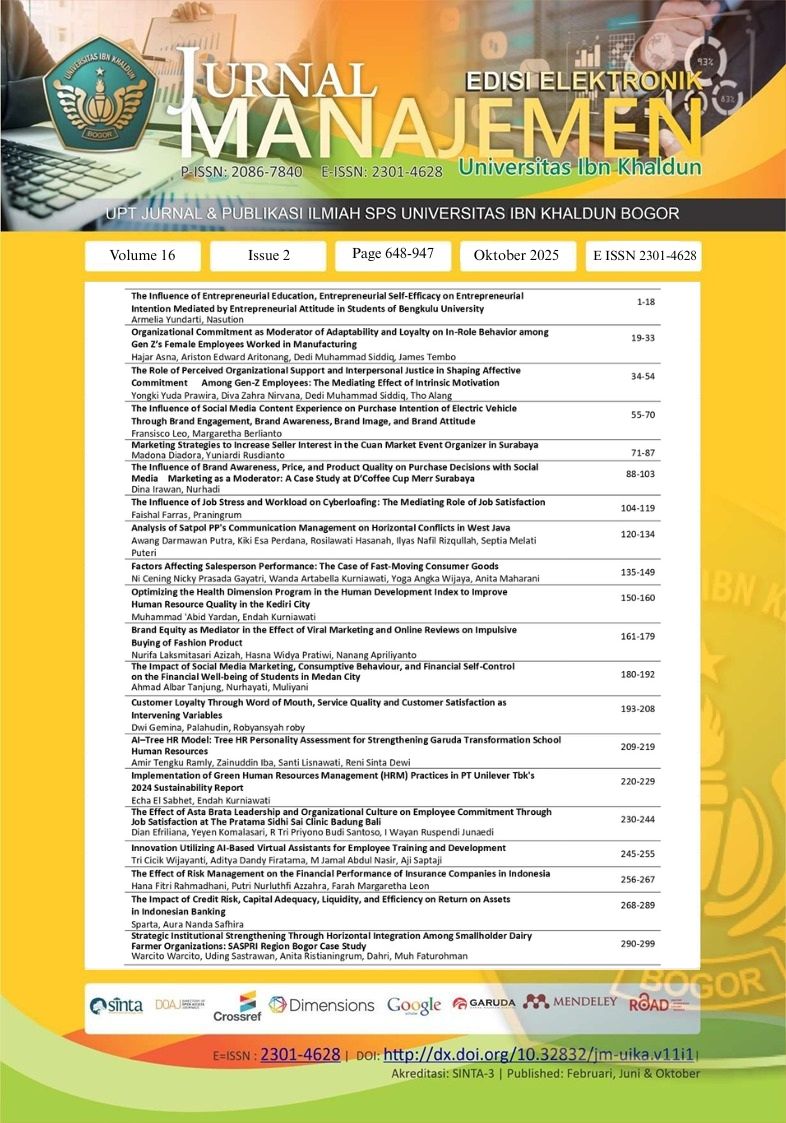
Organizational Commitment as Moderator of Adaptability and Loyalty on In-Role Behavior among Gen Z’s Female Employees Worked in Manufacturing
DOI:
https://doi.org/10.32832/jm-uika.v17i1.20146Keywords:
Adaptability, Employee Loyalty, In-Role Behavior, Organizational Commitment, Gen-Z Female EmployeesAbstract
The aim of this study is to examine how adaptability and loyalty influence in-role behavior among Generation-Z female employees in the manufacturing sector, with organizational commitment as a moderating variable. Grounded in behavioral and organizational psychology concepts, this study highlights adaptability and loyalty as key employee attributes in today’s dynamic work environment. A quantitative approach was employed using a survey method, with data collected from 217 respondents. The data were analyzed using Structural Equation Modeling (SEM) via SmartPLS 4. The results indicate that both adaptability and loyalty have a positive and significant impact on in-role behavior. Furthermore, organizational commitment is found to strengthen these relationships. The implications of these findings suggest that human resource management should prioritize the development of adaptability, loyalty, and organizational commitment to enhance employee performance and responsiveness in the evolving manufacturing sector, particularly among Generation-Z females.
References
Albrecht, S. L., Bakker, A. B., Gruman, J. A., Macey, W. H., & Saks, A. M. (2015). Employee engagement, human resource management practices and competitive advantage: An integrated approach. Journal of Organizational Effectiveness: People and Performance, 2(1), 7–35. https://doi.org/10.1108/JOEPP-08-2014-0042
Arif, M. (2020). Generational differences in work values and attitudes: A study on Gen Z. International Journal of Business and Management, 15(6), 15–24.
Bahri, A. S., Munawar, H., Widayati, & Sunimah. (2024). Kepuasan kerja mediasi: Kepemimpinan dan budaya organisasi terhadap komitmen organisasi. Jurnal Manajemen Kewirausahaan Dan Ilmu Sosial Asia, 4(2), 852–864.
Bougie, R. (2024). Organizational commitment as a mediator in the relationship between adaptability and employee performance. Journal of Organizational Behavior, 45(3), 567–589. https://doi.org/10.1002/job.2567
Budiman, A., & Sari, P. (2023). Apakah Gen Z memiliki budaya organisasi dan komitmen organisasional yang berperan dalam meningkatkan kinerja karyawan? Jurnal Madani, 15(2), 123–135.
Chin, W. W. (1998). The partial least squares approach for structural equation modeling. In G. A. Marcoulides (Ed.), Modern Methods for Business Research. Lawrence Erlbaum Associates Publishers.
Fauziana, E., Maulana, S., Junianto, O., & Anggiani, S. (2021). Pengaruh loyalitas karyawan (Organizational Citizenship Behavior) dan penerapan teori dua faktor (Two Factor Theories) terhadap kinerja perusahaan. Syntax Literate: Jurnal Ilmiah Indonesia, 6(2), 1–15. https://doi.org/10.36418/syntax-literate.v6i2.544
Goh, E., & Lee, C. (2018). A workforce to be reckoned with: The emerging pivotal Gen Z hospitality workforce. International Journal of Hospitality Management, 73, 20–28. https://doi.org/10.1016/ j.ijhm.2018.01.016
Hair, J. F., Hult, G. T. M., Ringle, C. M., & Sarstedt, M. (2021). Evaluation of reflective measurement models. In Partial least squares structural equation modeling (PLS-SEM) using R (pp. 75–90). Springer. https://doi.org/10.1007/978-3-030-80519-7_4
Hakim, A., & Fernandes, A. A. R. (2017). Mediating effect of work motivation on the influence of emotional intelligence and organizational culture against employee performance. Journal of Management Development, 36(7), 973–983. https://doi.org/10.1108/JMD-12-2016-0314
Hasan, M., Fitria, H., & Herlina, S. (2020). The effect of locus of control on employee performance with organizational commitment as moderation variable. International Journal of Multicultural and Multireligious Understanding (IJMMU), 7(1), 241–248. https://doi.org/10.18415/ijmmu.v7i1. 1341
Lestari, Y. I. F. (2023). Faktor loyalitas karyawan Generasi Z: Kepuasan kerja sebagai mediasi. Jurnal Manajemen Maranatha, 21(1), 45–58.
Li, Y., Xu, S., Tu, Y., & Lu, X. (2020). Organizational support and adaptive performance: The revolving door of work engagement and job crafting. Sustainability, 12(12), 4872. https://doi.org/10.3390/su12124872
Meyer, J. P., & Allen, N. J. (1991). A three-component conceptualization of organizational commitment. Human Resource Management Review, 1(1), 61–89.
Meyer, J. P., & Allen, N. J. (1997). Commitment in the workplace: Theory, research, and application. SAGE Publications. https://doi.org/10.4135/9781452231556
Meyer, J. P., & Herscovitch, L. (2001). Commitment in the workplace: Toward a general model. Human Resource Management Review, 11(3), 299–326.
Ng, T. W. H., & Feldman, D. C. (2012). Employee voice behavior: A meta‐analytic test of the conservation of resources framework. Journal of Organizational Behavior, 33(2), 216–234. https://doi.org/10.1002/job.754
Osho, O. K. (2023). Employee loyalty and organizational performance. Journal of Contemporary Research in Business and Economics, 6(1), 1–10. https://doi.org/10.56565/jcrbe.v6i1.99
Park, J., & Park, M. (2019). Conceptual framework of adaptive expertise for organizational learning: The role of learning goals and personal networks. Journal of Workplace Learning, 31(2), 124–145. https://doi.org/10.1108/JWL-07-2018-0093
Ployhart, R., & Bliese, P. (2006). Individual adaptability (I-ADAPT) theory: Conceptualizing the antecedents, consequences, and measurement of individual differences in adaptability. In Understanding Adaptability: A Prerequisite for Effective Performance within Complex Environments (Vol. 6, pp. 3–39). Elsevier. https://doi.org/10.1016/S1479-3601(05)06001-7
Prasetio, A. P., Yuniarsih, T., & Ahman, E. (2019). The effect of organizational commitment and work satisfaction on adaptive performance of employees. International Journal of Recent Technology and Engineering, 8(3), 6401–6405. https://doi.org/10.35940/ijrte.C6182.098319
Presser, S., Couper, M. P., Lessler, J. T., Martin, E., Martin, J., Rothgeb, J. M., & Singer, E. (2004). Methods for testing and evaluating survey questions. Public Opinion Quarterly, 68(1), 109–130. https://doi.org/10.1093/poq/nfh008
Prieto, I. M., & Pérez Santana, P. (2012). Building ambidexterity: The role of human resource practices in the performance of firms from Spain. Human Resource Management, 51(2), 189–211. https://doi.org/10.1002/hrm.21463
Pulakos, E. D., Arad, S., Donovan, M. A., & Plamondon, K. E. (2000). Adaptability in the workplace: Development of a taxonomy of adaptive performance. Journal of Applied Psychology, 85(4), 612–624.
Robbins, S. P., & Judge, T. A. (2019). Organizational behavior. Pearson.
Robbins, S. P., & Stubberud, H. A. (2019). Influences of social media on generation Y and gen Z consumers. Journal of Business Diversity, 19(3), 77–89. https://doi.org/10.33423/jbd.v19i3.2212
Sugeng, R., Amalia, R., Deputri, S. T. W., Siddiq, D. M., Syaroni, B., & Mustafa, T. (2024). Employee job security, emotional stability, and adaptability in predicting employee retention among gen Z employees. International Journal of Entrepreneurship and Business Development, 7(3), 589–597.
Twenge, J. M., Campbell, S. M., Hoffman, B. J., & Lance, C. E. (2010). Generational differences in work values: Leisure and extrinsic values increasing, social and intrinsic values decreasing. Journal of Management, 36(5), 1117–1142. https://doi.org/10.1177/0149206309352246
Widyastuti, T., & Hidayat, R. (2021). The effect of organizational commitment and work motivation on employee performance. Journal of Multidisciplinary Academic, 5(1), 1–5. https://doi.org/10.36 341/jma.v5i1.1873
Williams, L. J., & Anderson, S. E. (1991). Job satisfaction and organizational commitment as predictors of organizational citizenship and in-role behaviors. Journal of Management, 17(3), 601–617. https://doi.org/10.1177/014920639101700305
Wulandari, N., & Burgess, J. (2011). The link between work-life balance practices and organizational performance: A study of retail and hospitality industries in Indonesia. Journal of Management and Organization, 17(2), 224–236. https://doi.org/10.1017/S1833367200001580
Xu, Y., Li, X., & Chau, P. Y. K. (2020). Understanding the role of technology in health information seeking: A structural equation modeling approach. Journal of the Association for Information Science and Technology, 71(6), 686–700.
Yousef, D. A. (2017). Organizational commitment, job satisfaction and attitudes toward organizational change: A study in the local government. International Journal of Public Administration, 40(1), 77–88. https://doi.org/10.1080/01900692.2015.1072217
Downloads
Published
How to Cite
Issue
Section
License
Copyright (c) 2026 Jurnal Manajemen

This work is licensed under a Creative Commons Attribution-NonCommercial 4.0 International License.
Authors who publish with this journal agree to the following terms:
- Authors retain copyright and grant the journal right of first publication with the work simultaneously licensed under a Creative Commons Attribution-NonCommercial-ShareAlike 4.0 International License that allows others to share the work with an acknowledgement of the work's authorship and initial publication in this journal.
- Authors can enter into separate, additional contractual arrangements for the non-exclusive distribution of the journal's published version of the work (e.g., post it to an institutional repository or publish it in a book), with an acknowledgement of its initial publication in this journal.
- Authors are permitted and encouraged to post their work online (e.g., in institutional repositories or on their website) prior to and during the submission process, as it can lead to productive exchanges, as well as earlier and greater citation of published work (See The Effect of Open Access).