
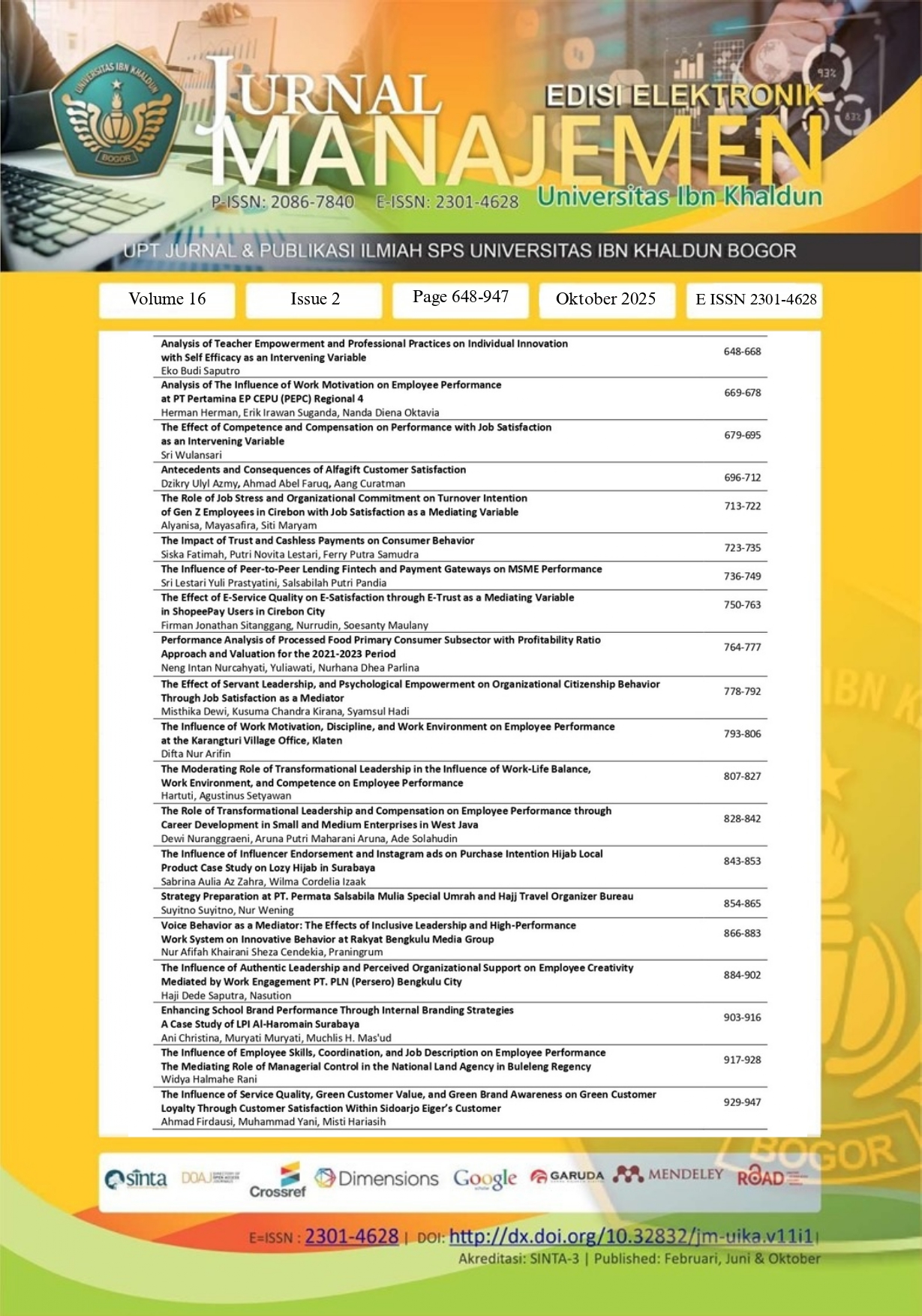
Enhancing School Brand Performance Through Internal Branding Strategies
A Case Study of LPI Al-Haromain Surabaya
DOI:
https://doi.org/10.32832/jm-uika.v16i2.20688Keywords:
Internal branding, brand commitment, brand loyalty, brand performance, Islamic educationAbstract
This study investigates the role of internal branding in enhancing school brand performance, mediated by brand commitment and brand loyalty, within Islamic educational institutions. A quantitative approach was applied using data from 92 educators and staff members at five school units managed by LPI Al-Haromain Surabaya. The population of this study consists of all educators and staff members of LPI Al-Haromain Surabaya, totaling fewer than 100 individuals. Therefore, saturated sampling was applied, in which all population members were included as respondents. Data analysis was conducted through Structural Equation Modeling using the PLS-SEM method. The results indicate that internal branding significantly boosts brand performance and brand commitment, while its impact on brand loyalty does not lead to improved performance. Brand commitment acts as a key mediator, whereas brand loyalty lacks significant influence without active engagement. Grounded in the theoretical frameworks of Resource-Based View (RBV), Social Exchange Theory, and Brand Equity Theory, the study highlights internal branding as a strategic driver of employee alignment with brand values. The study contributes to the literature by addressing a population gap, as most internal branding studies have focused on industry and higher education contexts. It further introduces the concept of educators as internal brand ambassadors and "teachers as school ambassadors," affirming their role in embodying and delivering brand values in daily interactions with students and parents.
References
Aslam, M., Gillani, S. H. M., Usman, M., Amjad, F., & Baig, S. A. (2023). Impact of internal brand management on brand performance: an empirical investigation of fashion brand. Journal of Promotion Management, 29(3), 405–426.
Barney, J. B., & Hesterly, W. S. (2019). Strategic management and competitive advantage: Concepts and cases. Pearson.
Bieńkowska, A., Sałamacha, A., & Tworek, K. (2020). The role of employees in shaping brand performance. Forum Scientiae Oeconomia, 8(2), 93–107.
Blau, P. (2017). Exchange and power in social life. Routledge.
Clark, P., Chapleo, C., & Suomi, K. (2020). Branding higher education: An exploration of the role of internal branding on middle management in a university rebrand. Tertiary Education and Management, 26(2), 131–149.
El Sheikh, S. A. H., Assaad, R. Y., Halim, Y. T., & Emara, O. A. M. (2024). The impact of sustainable internal branding on teaching staff’s commitment: application on private higher education institutions. Journal of Marketing for Higher Education, 1–26.
Gulati, C., Mathur, G., & Upadhyay, Y. (2023). Internal branding: connecting links to establish employees’ brand behaviour in hospitality sector. FIIB Business Review, 23197145221143830.
Iyer, P., Davari, A., & Paswan, A. (2018). Determinants of brand performance: The role of internal branding. Journal of Brand Management, 25, 202–216.
Kolla, N., Prasad, R., & Devi, G. (2019). Impact of internal branding on employees’ job satisfaction, brand commitment and brand citizenship behaviour. International Journal On Emerging Technologies. Https://Www. Researchtrend. Net/Ijet/Pdf.
Kucharska, W. (2020). Employee commitment matters for CSR practice, reputation and corporate brand performance—European model. Sustainability, 12(3), 940.
Ngo, L. V., Nguyen, N. P., Huynh, K. T., Gregory, G., & Cuong, P. H. (2020). Converting internal brand knowledge into employee performance. Journal of Product & Brand Management, 29(3), 273–287.
Özçelik, G., & Fındıklı, M. A. (2014). The relationship between internal branding and organizational citizenship behaviour: The mediating role of person-organization fit. Procedia-Social and Behavioral Sciences, 150, 1120–1128.
Punjaisri, K., & Wilson, A. (2017). The role of internal branding in the delivery of employee brand promise. Advances in Corporate Branding, 91–108.
Sholihah, T. (2018). Strategi Manajemen Humas Dalam Menciptakan School Branding Pada Sekolah Islam Terpadu. J-MPI (Jurnal Manajemen Pendidikan Islam), 3(2), 72–84.
Soleimani, M., Dana, L. P., Salamzadeh, A., Bouzari, P., & Ebrahimi, P. (2023). The effect of internal branding on organisational financial performance and brand loyalty: mediating role of psychological empowerment. Journal of Asian Business and Economic Studies, 30(2), 143–163.
Yu, Q., Yen, D. A., Barnes, B. R., & Huang, Y.-A. (2019). Enhancing firm performance through internal market orientation and employee organizational commitment. The International Journal of Human Resource Management, 30(6), 964–987.
Zhang, R., Wu, Y., & Ye, C. (2022). Promoting the brand inside: The conceptualization of nonprofit internal branding and its relationship with employees’ brand performance. Frontiers in Psychology, 13, 722057.
Downloads
Published
How to Cite
Issue
Section
License
Copyright (c) 2025 Jurnal Manajemen (Edisi Elektronik)

This work is licensed under a Creative Commons Attribution-NonCommercial 4.0 International License.
Authors who publish with this journal agree to the following terms:
- Authors retain copyright and grant the journal right of first publication with the work simultaneously licensed under a Creative Commons Attribution-NonCommercial-ShareAlike 4.0 International License that allows others to share the work with an acknowledgement of the work's authorship and initial publication in this journal.
- Authors can enter into separate, additional contractual arrangements for the non-exclusive distribution of the journal's published version of the work (e.g., post it to an institutional repository or publish it in a book), with an acknowledgement of its initial publication in this journal.
- Authors are permitted and encouraged to post their work online (e.g., in institutional repositories or on their website) prior to and during the submission process, as it can lead to productive exchanges, as well as earlier and greater citation of published work (See The Effect of Open Access).