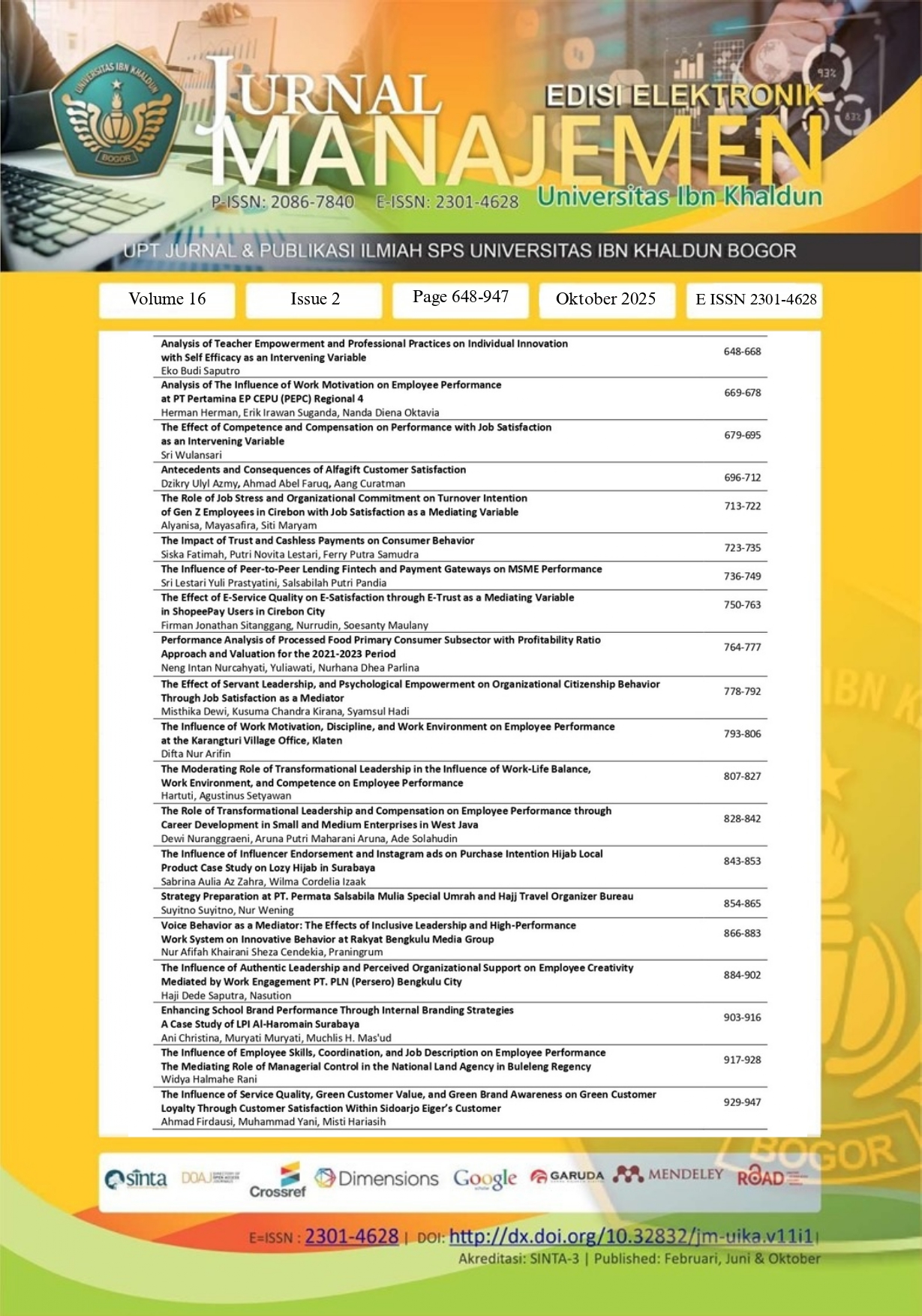
The Influence of Authentic Leadership and Perceived Organizational Support on Employee Creativity Mediated by Work Engagement PT. PLN (Persero) Bengkulu City
DOI:
https://doi.org/10.32832/jm-uika.v16i2.20725Keywords:
authentic leadership, perceived organizational support, creativity, work engagementAbstract
Employers required intelligent and innovative employees to devise novel method to enchange their business, including authentic leadership, the excent to which employees feel supported by their superiors, and their level of engagement at PT. PLN (Persero) in Bengkulu City. This quantitative study used first-hand information from people who filled out a questionnaire. 265 workers out of 298 workers at PT PLN (Persero) Bengkulu City were selected for this study using stratified random sampling method. SEM (Structural Equation Modeling) with SmartPLS 3 software was used to look at the data in this study. The study's findings led to the following conclusions: (1) authentic leadership has a positive and significant effect on employee creativity; (2) perceived organizational support does not have an effect on employee creativity; (3) authentic leadership has a significant and positive effect on work engagement; (4) perceived organizational support has a significant positive effect on work engagement; (5) work engagement has a significant positive effect on employee creativity; (6) work engagement can mediate the effect of authentic leadership on employee creativity. (7) The impact of perceived organizational support on employee creativity is mediated by work engagement. PT PLN (Persero) Bengkulu City anticipates that this research will contribute to the resolution of challenges, particularly in the domains of authentic leadership, perceived organizational support, and the impact of work engagement on employee creativity.
References
Adil, M. S., Hamid, K. B. A., & Waqas, M. (2020). Impact of perceived organisational support and workplace incivility on work engagement and creative work involvement: a moderating role of creative self-efficacy. International Journal of Management Practice, 13(2), 117. https://doi.org/10.1504/IJMP.2020.105671
Aldabbas, H., Pinnington, A., & Lahrech, A. (2023). The influence of perceived organizational support on employee creativity: The mediating role of work engagement. Current Psychology, 42(8), 6501–6515. https://doi.org/10.1007/s12144-021-01992-1
Alzghoul, A., Elrehail, H., Emeagwali, O. L., & AlShboul, M. K. (2018). Knowledge management, workplace climate, creativity and performance. Journal of Workplace Learning, 30(8), 592–612. https://doi.org/10.1108/JWL-12-2017-0111
Amabile, T. M., Amabile, T. M., Collins, M. A., Conti, R., Phillips, E., Picariello, M., Ruscio, J., & Whitney, D. (2018). Creativity in Context. Routledge. https://doi.org/10.4324/9780429501234
Bakker, A. B., Petrou, P., Op den Kamp, E. M., & Tims, M. (2020). Proactive Vitality Management, Work Engagement, and Creativity: The Role of Goal Orientation. Applied Psychology, 69(2), 351–378. https://doi.org/10.1111/apps.12173
Başaran, R., & KIRAL, E. (2022). The Relationship between Authentic Leadership and Work Engagement. International Journal of Contemporary Educational Research, 7(2), 351–365. https://doi.org/10.33200/ijcer.767560
Can, Ü., Kiliçalp, M., & Akyürek, S. (2025). The Role of Service Innovation and Work Engagement on Creativity and Training-Learning Effort. International Journal of Hospitality & Tourism Administration, 26(2), 425–455. https://doi.org/10.1080/15256480.2024.2321568
Chaudhary, R., & Akhouri, A. (2019). CSR perceptions and employee creativity: examining serial mediation effects of meaningfulness and work engagement. Social Responsibility Journal, 15(1), 61–74. https://doi.org/10.1108/SRJ-01-2018-0018
Dai, K., & Qin, X. (2016). Perceived Organizational Support and Employee Engagement: Based on the Research of Organizational Identification and Organizational Justice. Open Journal of Social Sciences, 04(12), 46–57. https://doi.org/10.4236/jss.2016.412005
Duan, W., Tang, X., Li, Y., Cheng, X., & Zhang, H. (2020). Perceived Organizational Support and Employee Creativity: The Mediation Role of Calling. Creativity Research Journal, 32(4), 403–411. https://doi.org/10.1080/10400419.2020.1821563
Fateh, A., & Mustamil, N. (2021). Role of authentic leadership and personal mastery in predicting employee creative behavior : a self-determination perspective. 1, 1–16.
Gonlepa, M. K., Dilawar, S., & Amosun, T. S. (2023). Understanding employee creativity from the perspectives of grit, work engagement, person organization fit, and feedback. Frontiers in Psychology, 13. https://doi.org/10.3389/fpsyg.2022.1012315
Hsieh, C. C., & Wang, D. S. (2015). Does supervisor-perceived authentic leadership influence employee work engagement through employee-perceived authentic leadership and employee trust? International Journal of Human Resource Management, 26(18), 2329–2348. https://doi.org/10.1080/09585192.2015.1025234
Hughes, D. J., Lee, A., Tian, A. W., Newman, A., & Legood, A. (2018). Leadership, creativity, and innovation: A critical review and practical recommendations. The Leadership Quarterly, 29(5), 549–569. https://doi.org/10.1016/j.leaqua.2018.03.001
Ibrahim, H. I., Isa, A., & Shahbudin, A. S. M. (2016). Organizational Support and Creativity: The Role of Developmental Experiences as a Moderator. Procedia Economics and Finance, 35, 509–514. https://doi.org/10.1016/S2212-5671(16)00063-0
Imran, M. Y., Elahi, N. S., Abid, G., Ashfaq, F., & Ilyas, S. (2020). Impact of Perceived Organizational Support on Work Engagement: Mediating Mechanism of Thriving and Flourishing. Journal of Open Innovation: Technology, Market, and Complexity, 6(3), 82. https://doi.org/10.3390/joitmc6030082
Inam, A., Ho, J. A., Zafar, H., Khan, U., Sheikh, A. A., & Najam, U. (2021). Fostering Creativity and Work Engagement Through Perceived Organizational Support: The Interactive Role of Stressors. Sage Open, 11(3). https://doi.org/10.1177/21582440211046937
Jankelová, N., Joniaková, Z., & Skorková, Z. (2021). Perceived Organizational Support and Work Engagement of First-Line Managers in Healthcare – The Mediation Role of Feedback Seeking Behavior. Journal of Multidisciplinary Healthcare, Volume 14, 3109–3123. https://doi.org/10.2147/JMDH.S326563
Joo, B.-K., Yim, J.-H., Jin, Y. S., & Han, S. J. (2023). Empowering leadership and employee creativity: the mediating roles of work engagement and knowledge sharing. European Journal of Training and Development, 47(9), 881–899. https://doi.org/10.1108/EJTD-02-2022-0016
Junça Silva, A., & Lopes, C. (2023). Cognitive and affective predictors of occupational stress and job performance: the role of perceived organizational support and work engagement. Journal of Economic and Administrative Sciences, 39(4), 1013–1026. https://doi.org/10.1108/JEAS-02-2021-0020
Karatepe, O. M., & Aga, M. (2016). The effects of organization mission fulfillment and perceived organizational support on job performance. International Journal of Bank Marketing, 34(3), 368–387. https://doi.org/10.1108/IJBM-12-2014-0171
Khan, A. N., Khan, N. A., Bodla, A. A., & Gul, S. (2020). Impact of psychopathy on employee creativity via work engagement and negative socioemotional behavior in public health sector. Personnel Review, 49(8), 1655–1675. https://doi.org/10.1108/PR-02-2019-0072
Lei, S., Qin, C., Ali, M., Freeman, S., & Shi-Jie, Z. (2021). The impact of authentic leadership on individual and team creativity: a multilevel perspective. Leadership and Organization Development Journal, 42(4), 644–662. https://doi.org/10.1108/LODJ-12-2019-0519
M.Amabile, T. (1988). A MODEL OF CREATIVITY AND INNOVATION IN ORGANIZATIONS. Research in Organizational Behavior, 10(1), 123–167.
Mubarak, F., & Noor, A. (2018). Effect of authentic leadership on employee creativity in project-based organizations with the mediating roles of work engagement and psychological empowerment. Cogent Business & Management, 5(1), 1. https://doi.org/10.1080/23311975.2018.1429348
Musenze, I. A., Mayende, T. S., Wampande, A. J., Kasango, J., & Emojong, O. R. (2021). Mechanism between perceived organizational support and work engagement: explanatory role of self-efficacy. Journal of Economic and Administrative Sciences, 37(4), 471–495. https://doi.org/10.1108/JEAS-02-2020-0016
Niswaty, R., Wirawan, H., Akib, H., Saggaf, M. S., & Daraba, D. (2021). Investigating the effect of authentic leadership and employees’ psychological capital on work engagement: evidence from Indonesia. Heliyon, 7(5), e06992. https://doi.org/10.1016/j.heliyon.2021.e06992
Oh, J., Cho, D., & Lim, D. H. (2018). Authentic leadership and work engagement: the mediating effect of practicing core values. Leadership & Organization Development Journal, 39(2), 276–290. https://doi.org/10.1108/LODJ-02-2016-0030
Phuong, T. H., & Takahashi, K. (2021). The impact of authentic leadership on employee creativity in Vietnam: a mediating effect of psychological contract and moderating effects of subcultures. Asia Pacific Business Review, 27(1), 77–100. https://doi.org/10.1080/13602381.2021.1847467
Rhoades, L., & Eisenberger, R. (2002). Perceived organizational support: A review of the literature. Journal of Applied Psychology, 84(4), 689.
Ribeiro, N., Duarte, A. P., Filipe, R., & Torres de Oliveira, R. (2020). How Authentic Leadership Promotes Individual Creativity: The Mediating Role of Affective Commitment. Journal of Leadership & Organizational Studies, 27(2), 189–202. https://doi.org/10.1177/1548051819842796
Samsudin, A., Saputra, N., & Abdinegoro, S. B. (2020). Authentic Leadership, Work Engagement and Performance. Proceedings of the International Conference on Business and Management Research (ICBMR 2020). https://doi.org/10.2991/aebmr.k.201222.040
Sanda, A., & Arthur, N. A. D. (2017). Relational impact of authentic and transactional leadership styles on employee creativity. African Journal of Economic and Management Studies, 8(3), 274–295. https://doi.org/10.1108/AJEMS-07-2016-0098
Schaufeli, W. B., Salanova, M., González-romá, V., & Bakker, A. B. (2002). The Measurement of Engagement and Burnout: A Two Sample Confirmatory Factor Analytic Approach. Journal of Happiness Studies, 3, 71–92. https://doi.org/10.1023/A:1015630930326
Semedo, A. S., Coelho, A., & Ribeiro, N. (2018). The relationship between authentic leaders and employees’ creativity. International Journal of Workplace Health Management, 11(2), 58–73. https://doi.org/10.1108/IJWHM-06-2017-0048
Semedo, A. S. D., Coelho, A. F. M., & Ribeiro, N. M. P. (2016). Effects of authentic leadership, affective commitment and job resourcefulness on employees’ creativity and individual performance. Leadership & Organization Development Journal, 37(8), 1038–1055. https://doi.org/10.1108/LODJ-02-2015-0029
Sengupta, S., Sharma, S., & Singh, A. (2021). Authentic Leadership Fostering Creativity in Start-ups: Mediating Role of Work Engagement and Employee Task Proactivity. Business Perspectives and Research, 9(2), 235–251. https://doi.org/10.1177/2278533720964298
Stander, F. W., De Beer, L. T., & Stander, M. W. (2015). Authentic leadership as a source of optimism, trust in the organisation and work engagement in the public health care sector. SA Journal of Human Resource Management, 13(1). https://doi.org/10.4102/sajhrm.v13i1.675
Suifan, T. S., Abdallah, A. B., & Al Janini, M. (2018). The impact of transformational leadership on employees’ creativity. Management Research Review, 41(1), 113–132. https://doi.org/10.1108/MRR-02-2017-0032
Tian, W., Wang, H., & Rispens, S. (2021). How and When Job Crafting Relates to Employee Creativity: The Important Roles of Work Engagement and Perceived Work Group Status Diversity. International Journal of Environmental Research and Public Health, 18(1), 291. https://doi.org/10.3390/ijerph18010291
Toyama, H., & Mauno, S. (2017). Associations of Trait Emotional Intelligence with Social Support, Work Engagement, and Creativity in Japanese Eldercare Nurses. Japanese Psychological Research, 59(1), 14–25. https://doi.org/10.1111/jpr.12139
Wirawan, H., Jufri, M., & Saman, A. (2020). The effect of authentic leadership and psychological capital on work engagement: the mediating role of job satisfaction. Leadership & Organization Development Journal, 41(8), 1139–1154. https://doi.org/10.1108/LODJ-10-2019-0433
Xu, B.-D., Zhao, S.-K., Li, C.-R., & Lin, C.-J. (2017). Authentic leadership and employee creativity: testing the multilevel mediation model. Leadership & Organization Development Journal, 38(3), 482–498. https://doi.org/10.1108/LODJ-09-2015-0194
Ye, L., Li, Y., Zhang, N., & Zhang, J. (2024). The Influence of Work Engagement on Employee Affect and Creativity: Insights from Occupational Mental Health. Behavioral Sciences, 14(12), 1217. https://doi.org/10.3390/bs14121217
Zaitouni, M., & Ouakouak, M. L. (2018). Key predictors of individual creativity in a Middle Eastern culture. International Journal of Organizational Analysis, 26(1), 19–42. https://doi.org/10.1108/IJOA-03-2017-1139
Zeb, A., Abdullah, N. H., Hussain, A., & Safi, A. (2020). Authentic leadership, knowledge sharing, and employees’ creativity. Management Research Review, 43(6), 669–690. https://doi.org/10.1108/MRR-04-2019-0164
Zhang, L., Bu, Q., & Wee, S. (2016). Effect of perceived organizational support on employee creativity: Moderating role of job stressors. International Journal of Stress Management, 23(4), 400–417. https://doi.org/10.1037/str0000025
Downloads
Published
How to Cite
Issue
Section
License
Copyright (c) 2025 Jurnal Manajemen (Edisi Elektronik)

This work is licensed under a Creative Commons Attribution-NonCommercial 4.0 International License.
Authors who publish with this journal agree to the following terms:
- Authors retain copyright and grant the journal right of first publication with the work simultaneously licensed under a Creative Commons Attribution-NonCommercial-ShareAlike 4.0 International License that allows others to share the work with an acknowledgement of the work's authorship and initial publication in this journal.
- Authors can enter into separate, additional contractual arrangements for the non-exclusive distribution of the journal's published version of the work (e.g., post it to an institutional repository or publish it in a book), with an acknowledgement of its initial publication in this journal.
- Authors are permitted and encouraged to post their work online (e.g., in institutional repositories or on their website) prior to and during the submission process, as it can lead to productive exchanges, as well as earlier and greater citation of published work (See The Effect of Open Access).