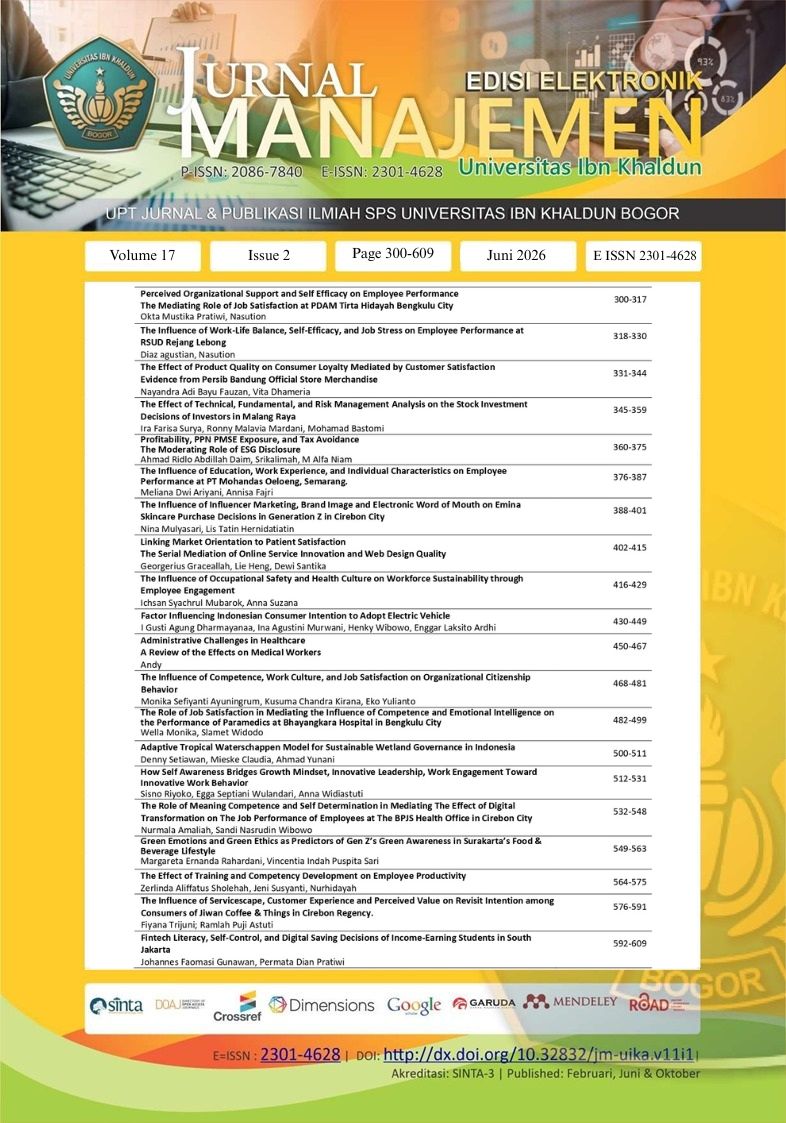
The Influence of Work-Life Balance, Self-Efficacy, and Job Stress on Employee Performance at RSUD Rejang Lebong
DOI:
https://doi.org/10.32832/jm-uika.v17i2.21697Keywords:
Work-Life Balance, self-efficacy, Job Stress, Employee PerformanceAbstract
The objective of this research was to investigate the influence of Work-Life Balance, Self-Efficacy, and Job Stress on employee performance within the Rejang Lebong Regional General Hospital. This study adopted a quantitative research design utilizing a survey questionnaire as the primary data collection instrument. Data were distributed directly to respondents in physical form and digitally via Google Forms. Multiple linear regression analysis was employed to analyze the data. The study's population consisted of 620 employees engaged in health services and hospital administration. The random sampling technique was utilized, and the minimum sample size was determined using Hair's formula, resulting in a total of 240 respondents. Data processing and analysis were conducted using SmartPLS software. The results indicate that Work-Life Balance demonstrates a significant positive effect on performance, suggesting that a better equilibrium between work and personal life is associated with increased employee performance. Self-Efficacy also exhibits a significant positive influence, as self-belief enables employees to complete tasks more effectively, demonstrate persistence, and adapt to pressure. Conversely, job stress has a significant negative effect, as high levels of stress resulting from workload and pressure reduce employee motivation, concentration, and performance effectiveness.
References
Alfiansyah, M. (2021). Pengaruh Kompensasi dan Kepuasan Kerja Terhadap Kinerja Karyawan di Rumah Sakit Umum Jampangkulon. Jurnal Ilmiah Magister Manajemen, 4(1), 145–155. https://jurnal.umsu.ac.id/index.php/MANEGGIO/article/view/6774/5435
Ardiansyah, C. A., & Surjanti, J. (2020). Pengaruh Work Life Balance terhadap Kinerja Karyawan melalui Komitmen Organisasi pada Karyawan PT. Bhinneka Life Indonesia Cabang Surabaya. Jurnal Ilmu Manajemen, 8(4), 1211. https://doi.org/10.26740/jim.v8n4.p1211-1221
Arifin, M., & Muharto, A. (2022). Pengaruh Worklife Balance Terhadap Kinerja Karyawan (Studi Pada PT. Livia Mandiri Sejati Pasuruan). Jurnal Riset Ekonomi Dan Bisnis, 15(1), 37. https://doi.org/10.26623/jreb.v15i1.3507
Darmawan, D., Mardikaningsih, R., Arifin, S., Sinambela, E. A., & Putra, A. R. (2021). Studi Tentang Peranan Variabel Kompetensi, Penilaian Kinerja, dan Kondisi Kerja Terhadap Perwujudan Kepuasan Kerja Guru. Jurnal Pendidikan Dan Kewirausahaan, 9(2), 516–530. https://doi.org/10.47668/pkwu.v9i2.317
Hair, J. F. (2014). No TitleA primer on partial least squares structural equation modeling (PLS-SEM).
Henseler, J., Ringle, C. M., & Sarstedt, M. (2015). A new criterion for assessing discriminant validity in variance-based structural equation modeling. Journal of the Academy of Marketing Science, 43(1), 115–135. https://doi.org/10.1007/s11747-014-0403-8
Herlambang, H. C. ; R. M. (2019). PENGARUHWORKLIFEBALANCETERHADAPKINERJAKARYAWAN DENGANKEPUASANKERJASEBAGAIVARIABELINTERVENING (Studi Empiris pada Serikat Pekerja Media dan Industri Kreatif Untuk Demokrasi (SINDIKASI)). From Stress to Wellbeing Volume 2.
Jannah, R., Husen, T. I., & Rafiie, S. A. K. (2023). Pengaruh Self Efficacy Terhadap Kinerja Karyawan Melalui Kepuasan Kerja Sebagai Variabel Mediasi di PT. Dunia Barusa Toyota Meulaboh Aceh Barat. Jurnal Pelita Nusantara, 1(3), 393–409. https://doi.org/10.59996/jurnalpelitanusantara.v1i3.288
M Ardan, A. J. (n.d.). MANAJEMEN SUMBER DAYA MANUSIA: Turnover Intention Dapat Mempengaruhi Kulaitas Kinerja Perusahaan (2021st ed.).
Mahawati, G., & Sulistiyani, E. (2021). Efikasi Diri Dan Disiplin Kerja Serta Pengaruhnya Terhadap Kinerja Karyawan. Bangun Rekaprima, 7(1), 62. https://doi.org/10.32497/bangunrekaprima.v7i1.2593
Mardiani, I. N., & Widiyanto, A. (2021). Pengaruh work-life balance, Lingkungan Kerja dan Kompensasi terhadap Kinerja karyawan PT Gunanusa Eramandiri. Jesya (Jurnal Ekonomi & Ekonomi Syariah), 4(2), 985–993. https://doi.org/10.36778/jesya.v4i2.456
Olii, C. F. R., Suwarno, H. L., & Hadianto, B. (2024). Work-Life Balance, Job Satisfaction, and Employee Loyalty. Journal of Economics and Business, 7(3), 262–272. https://doi.org/10.31014/aior.1992.07.03.610
Parashakti, R. D., & Ekhsan, M. (2022). Peran Burnout sebagai Mediasi pada Pengaruh Stres Kerja Terhadap Kinerja Karyawan. Jesya (Jurnal Ekonomi & Ekonomi Syariah), 5(1), 365–373. https://doi.org/10.36778/jesya.v5i1.609
Pradoto, H., Haryono, S., & Wahyuningsih, S. H. (2022). The role of work stress, organizational climate, and improving employee performance in the implementation of work from home. Work, 71(2), 345–355. https://doi.org/10.3233/WOR-210678
Pramudhita, G. V., & Izzati, U. A. (2022). Hubungan antara efikasi diri dengan keterikatan kerja pada karyawan bagian welder. Character: Jurnal Penelitian Psikologi, 9(4), 210–220. https://ejournal.unesa.ac.id/index.php/character/article/view/46796#:~:text=Berdasarkan hasil analisa tersebut dapat,kerja karyawan pada perusahaan tersebut.
Prasetya, A. S. E., Nyoto, Putra, R., & Sultan, F. M. M. (2023). Cyberloafing, Work Environment, and Leadership on Performance and Job Satisfaction of Education Personnel at Sultan Syarif Kasim State Islamic University Riau. Journal of Applied Business and Technology, 4(1), 17–29. https://doi.org/10.35145/jabt.v4i1.116
Puspitasari, S., & Fadhli, K. (2024). Pengaruh Self-Efficacy Dan Motivasi Memasuki Dunia Kerja Terhadap Work Readiness Pada Mahasiswa Universitas Kh. Abdul Wahab Hasbullah. Jae (Jurnal Akuntansi Dan Ekonomi), 9(1), 119–129. https://doi.org/10.29407/jae.v9i1.22232
Ramadhan, N. D., & Budiono. (2023). Pengaruh Self Efficacy dan Work Engagement terhadap Employee Performance melalui Job Satisfaction. Jurnal Ilmu Manajemen, 11(3), 783–796.
Ramadhan, R. A., & Tanuwijaya, J. (2023). Analisis Pengaruh Employee Performance Terhadap Career Growth Pada Tenaga Kesehatan Rumah Sakit di Kabupaten Tangerang. SEIKO: Journal of …, 6(1), 75–87. https://doi.org/10.37531/sejaman.v5i2.3364
Santri, S. P. D., Verawati, D. M., & Giovanni, A. (2023). Pengaruh Self Efficacy, Self Esteem dan Employee Engagement Terhadap Kinerja Karyawan Pada Perusahaan Daerah Air Minum Kota Magelang. Among Makarti, 16(1). https://doi.org/10.52353/ama.v16i1.441
Sari, D. L., Storyna, H., Intan, R., Sinaga, P., Gunawan, F. E., Asrol, M., & Redi, A. A. N. P. (2021). The effect of job stress to employee performance: Case study of manufacturing industry in Indonesia. IOP Conference Series: Earth and Environmental Science, 794(1). https://doi.org/10.1088/1755-1315/794/1/012085
Silvi Aulia Rahmah, Andarini, D., Anggraini, R., & Idris, H. (2024). Pengaruh stress kerja dan motivasi kerja terhadap kinerja pegawai : literature review. Jurnal Lentera Kesehatan Masyarakat, 3(2), 67–75. https://doi.org/10.69883/ggke2h70
SYIFA, M. A., & EKOWATI, V. M. (2022). Pengaruh Self Efficacy Terhadap Kinerja Karyawan Dengan Kepuasan Kerja Sebagai Variabel Mediasi Pada Dinas Pekerjaan Umum Kabupaten Tegal. Jurnal Dimensi, 11(3), 500–517. https://doi.org/10.33373/dms.v11i3.4283
Timbuleng, C., Lengkong, V. P. K., & Lumantow, R. Y. (2023). Pengaruh Work Life Balance, Beban Kerja dan Disiplin Kerja Terhadap Kinerja Pegawai di Dinas Koperasi dan Usaha Kecil Menengah Daerah Provinsi Sulawesi Utara. Jurnal EMBA : Jurnal Riset Ekonomi, Manajemen, Bisnis Dan Akuntansi, 11(4), 758–770. https://doi.org/10.35794/emba.v11i4.52201
Winoto, S. C. N. C. R., & Perkasa, D. H. (2024). Pengaruh Beban Kerja, Stres Kerja dan Lingkungan Kerja terhadap Kinerja Karyawan UP PKB Pulogadung. Revenue: Lentera Bisnis Manajemen, 2(01), 1–11. https://doi.org/10.59422/lbm.v2i01.86
Wongsuwan, N., Phanniphong, K., & Na-Nan, K. (2023). How Job Stress Influences Organisational Commitment: Do Positive Thinking and Job Satisfaction Matter? Sustainability (Switzerland), 15(4). https://doi.org/10.3390/su15043015
Wood, J., Oh, J., Park, J., & Kim, W. (2020). The Relationship Between Work Engagement and Work–Life Balance in Organizations: A Review of the Empirical Research. Human Resource Development Review, 19(3), 240–262. https://doi.org/10.1177/1534484320917560
Downloads
Published
How to Cite
Issue
Section
License
Copyright (c) 2026 Jurnal Manajemen

This work is licensed under a Creative Commons Attribution-NonCommercial 4.0 International License.
Authors who publish with this journal agree to the following terms:
- Authors retain copyright and grant the journal right of first publication with the work simultaneously licensed under a Creative Commons Attribution-NonCommercial-ShareAlike 4.0 International License that allows others to share the work with an acknowledgement of the work's authorship and initial publication in this journal.
- Authors can enter into separate, additional contractual arrangements for the non-exclusive distribution of the journal's published version of the work (e.g., post it to an institutional repository or publish it in a book), with an acknowledgement of its initial publication in this journal.
- Authors are permitted and encouraged to post their work online (e.g., in institutional repositories or on their website) prior to and during the submission process, as it can lead to productive exchanges, as well as earlier and greater citation of published work (See The Effect of Open Access).