AI–Tree HR Model
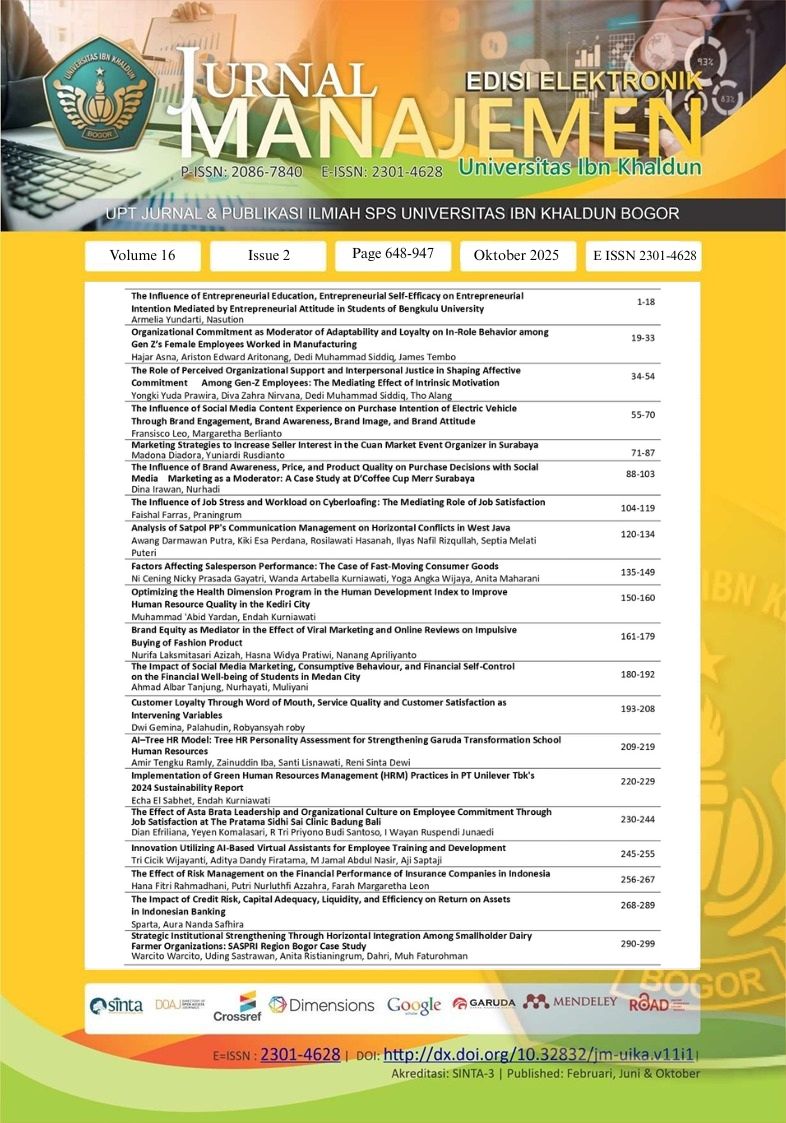
Tree HR Personality Assessment for Strengthening Garuda Transformation School Human Resources
DOI:
https://doi.org/10.32832/jm-uika.v17i1.21862Keywords:
Tree HR Personality, Manajemen SDMAbstract
National education transformation demands the strengthening of human resources (HR) with character, adaptability, and technological literacy. This article develops and tests the AI-Tree HR Model, a digital-based personality assessment system that integrates the HR Tree Personality with artificial intelligence. This model is built on the philosophy of the HR Tree Model (Ramly, 2023), which describes human development through three main structures: roots (values and spirituality), trunk (competence and mindset), and fruit/leaves (behavior and work results). This study uses a Research and Development (R&D) approach with the ADDIE framework and Agile Software Development principles. The research subjects consisted of 582 respondents (teachers, students, and principals) in a school environment who participated in the digital assessment based on the AI-Tree HR Personality System. Analysis was conducted using the Multi-Stage Weighted Index (MSWI) method on three main dimensions: ease of use, usability, and accuracy. The results show that the AI-Tree HR Personality system has high content validity and excellent reliability, with a total feasibility index of 92.7% (very feasible). AI integration improves the accuracy of assessment results, provides adaptive learning recommendations, and accelerates the process of mapping the character and potential of educators and students. Conceptually, this research expands the paradigm of local human resources, which are based on values and spirituality, with the support of AI technology. Practically, the implementation of the AI-Tree HR Model will strengthen Garuda School's position as a model for national education transformation based on character, values, and technology towards the vision of Golden Indonesia 2045.
References
Beck, K., Beedle, M., van Bennekum, A., Cockburn, A., Cunningham, W., Fowler, M., … Thomas, D. (2001). Manifesto for Agile Software Development. Agile Alliance. Retrieved from https://agilemanifesto.org/
Borg, W. R., & Gall, M. D. (1983). Educational Research: An Introduction (4th ed.). New York: Longman.
Branch, R. M. (2009). Instructional Design: The ADDIE Approach. New York: Springer.
Cheung, F. M., van de Vijver, F. J. R., & Leong, F. T. L. (2011). Toward a new approach to the study of personality in culture. American Psychologist, 66(7), 593–603. https://doi.org/10.1037/a0022389
Furnham, A. (2017). The Big Five Personality Factors at Work. London: Routledge.
Horwitz, F. M. (2017). Human resource management in Africa: A holistic approach. The International Journal of Human Resource Management, 28(14), 1965–1981. https://doi.org/10.1080/09585192.2015.1128462
Kemendikbudristek. (2023). Panduan Sekolah Garuda: Transformasi Pendidikan Berbasis Karakter dan Teknologi. Jakarta: Kementerian Pendidikan, Kebudayaan, Riset, dan Teknologi Republik Indonesia.
Krishnakumar, S., & Neck, C. P. (2019). The what, why, and how of spirituality in the workplace: A review and future research directions. Journal of Management, Spirituality & Religion, 16(1), 1–23. https://doi.org/10.1080/14766086.2018.1495096
McCrae, R. R., & Costa, P. T. Jr. (2008). The Five-Factor Theory of Personality. New York: Guilford Press.
OECD. (2021). The Future of Education and Skills 2030: OECD Learning Compass. Paris: Organisation for Economic Co-operation and Development.
Ramly, A. T. (2023). Tree HR Model of Human Resource Development in Higher Education. Bogor: Universitas Ibn Khaldun Press.
Ramly, A. T. (2024a). Tree HR Personality: Typology and Teacher Adaptability. In Proceedings of the International Islamic Conference on Applied Social Science (IICASS 2024). Atlantis Press.
Ramly, A. T. (2024b). Integrating Local Values into Personality Assessment: Innovation of the Tree HR Model for Human Capital in Education. SA Journal of Human Resource Management, 22(1), 1–15. https://doi.org/10.4102/sajhrm.v22i1.2245
Ramly, A. T. (2025). Tree HR Personality: Inovasi Tes Kepribadian Digital untuk SDM Pendidikan. Bogor: UIKA Press.
Sugiyono. (2020). Metode Penelitian Kuantitatif, Kualitatif, dan R&D. Bandung: Alfabeta.
World Bank. (2020). World Development Report 2020: Trading for Development in the Age of Global Value Chains. Washington, DC: The World Bank.
Downloads
Published
How to Cite
Issue
Section
License
Copyright (c) 2026 Jurnal Manajemen

This work is licensed under a Creative Commons Attribution-NonCommercial 4.0 International License.
Authors who publish with this journal agree to the following terms:
- Authors retain copyright and grant the journal right of first publication with the work simultaneously licensed under a Creative Commons Attribution-NonCommercial-ShareAlike 4.0 International License that allows others to share the work with an acknowledgement of the work's authorship and initial publication in this journal.
- Authors can enter into separate, additional contractual arrangements for the non-exclusive distribution of the journal's published version of the work (e.g., post it to an institutional repository or publish it in a book), with an acknowledgement of its initial publication in this journal.
- Authors are permitted and encouraged to post their work online (e.g., in institutional repositories or on their website) prior to and during the submission process, as it can lead to productive exchanges, as well as earlier and greater citation of published work (See The Effect of Open Access).