
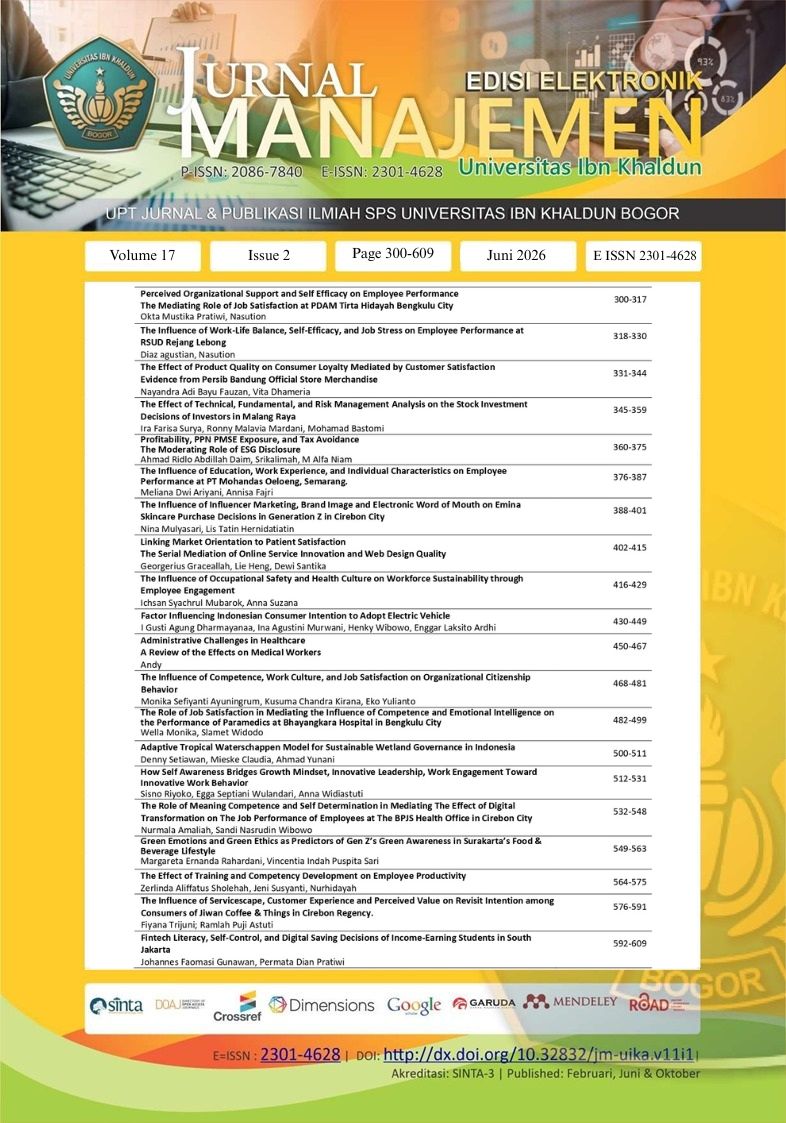
Linking Market Orientation to Patient Satisfaction
The Serial Mediation of Online Service Innovation and Web Design Quality
DOI:
https://doi.org/10.32832/jm-uika.v17i2.22009Keywords:
Keywords: Market Orientation, Consumer Satisfaction, Online Service Innovation, Web Design QualityAbstract
This study aims to investigate the impact of market orientation strategies on consumer satisfaction, with online service innovation and web design quality serving as mediating variables. The purpose of this study is to explain the relationship between the use of market orientation strategies and the creation of consumer satisfaction through the mediation variables of online service innovation and web design quality. The form of research uses associative methods. The sample was determined using the purposive sampling technique with the criteria of consumers who are registered as domiciled in Pontianak City and have been Prodia's subscribers for more than 3 years. Respondents were assigned as many as 160 people using the multivariate technique, analyzed using the SEM method through the AMOS application. From the test results, it was obtained that H1 was accepted, where market orientation had a positive and significant effect on online service innovation; then H2 was accepted, where market orientation had a positive and significant effect on design quality; then H4 was accepted, where online service innovation had a positive and significant effect on consumer satisfaction. Different results were obtained where H3 was rejected, where the design quality did not have a significant effect on consumer satisfaction, and then H5 was also rejected, where market orientation did not have a significant effect on consumer satisfaction.
References
Albalushi, M. A., Jano, Z., Devi, I., Abazeed, A., & Alkaabi, M. (2022). Measuring Website Quality using Service Quality and User Satisfaction Dimensions: A Conceptual Framework. Journal of Computer Science, 18(7), 674–686. https://doi.org/10.3844/jcssp.2022.674.686
Bakti, J. P. A., Rohman, F., & Sunaryo, S. (2019). Peran Keunggulan Bersaing Sebagai Mediasi Pengaruh Inovasi Dan Orientasi Pasar Terhadap Kepuasan Pelanggan. Jurnal Bisnis Dan Manajemen, 5(2), 181–190. https://doi.org/10.26905/jbm.v5i2.2665
Buhalis, D., Parra López, E., & Martinez-Gonzalez, J. A. (2020). Influence of young consumers’ external and internal variables on their e-loyalty to tourism sites. Journal of Destination Marketing & Management, 15, 100409. https://doi.org/10.1016/j.jdmm.2020.100409
Dirwan, D., & Themba, O. S. (2022). Keputusan Pembelian dari Aspek Desain Website, Kepercayaan, Keamanan dan Kemudahan. EKOMBIS REVIEW: Jurnal Ilmiah Ekonomi Dan Bisnis, 10(2), 1305–1314. https://doi.org/10.37676/ekombis.v10i2.2735
Erwin, E., Pasaribu, A. W., Novel, N. J. A., Thaha, A. R., Adhicandra, I., Suardi, C., & Syafaat, M. (2023). Transformasi Digital. PT. Sonpedia Publishing Indonesia.
Ghozali, I. (2021). Partial Least Squares: Konsep, Teknik dan Aplikasi Menggunakan Smart PLS 3.2.9 untuk Penelitian Empiris (3rd ed.). Badan Penerbit Universitas Diponegoro.
Hair, J. F., Gabriel, M. L. D. S., Silva, D. da, & Junior, S. B. (2019). Development and validation of attitudes measurement scales : fundamental and practical aspects. RAUSP, 54(4), 490–507. https://doi.org/10.1108/RAUSP-05-2019-0098
Harahap, D. B., Ridwan, M., & Rahmani, N. A. B. (2023). Pengaruh Website E-Commerce Dan Kualitas Produk Terhadap Loyalitas Melalui Kepuasan Konsumen Sebagai Variabel Intervening dan Prespektif Ekonomi Islam. Jurnal Ilmiah Ekonomi Islam, 9(2), 2667–2673. https://doi.org/10.29040/jiei.v9i2.9680
Herhausen, D., Emrich, O., Grewal, D., Kipfelsberger, P., & Schoegel, M. (2020). Face forward: How employees’ digital presence on service websites affects customer perceptions of website and employee service quality. Journal of Marketing Research, 57(5), 917–936. https://doi.org/10.1177/0022243720934863
Hult, G. T. M., Hurley, R. F., & Knight, G. A. (2004). Innovativeness: Its antecedents and impact on business performance. Industrial Marketing Management, 33(5), 429–438. https://doi.org/10.1016/j.indmarman.2003.08.015
Husain, T., & Sani, A. (2020). Kepuasan Pelanggan Toko Online Yang Dipengaruhi Kualitas Produk Dan Layanan. JITK (Jurnal Ilmu Pengetahuan Dan Teknologi Komputer), 5(2), 291–296. https://doi.org/10.33480/jitk.v5i2.614
Jyoti, J., & Sharma, J. (2012). Impact of Market Orientation on Business Performance: Role of Employee Satisfaction and Customer Satisfaction. Vision: The Journal of Business Perspective, 16(4), 297–313. https://doi.org/10.1177/0972262912460188
Klinik Prodia. (2024). https://www.prodia.co.id
Kohli, A. K., & Jaworski, B. J. (1990). Market orientation: The construct, research propositions, and managerial implications. Journal of Marketing, 54(2), 1–18. https://doi.org/10.1177/002224299005400201
Kusuma, G. P. E., Astana, I. G. M. O., Ningsih, N. N. A., Cattleyana, D., & Mustafa, Z. (2025). Analyzing the Influence of Service Quality in Water Distribution on Customer Complaints and Its Role in Enhancing Customer Satisfaction. International Journal of Economics Development Research (IJEDR), 6(1), 298–308. https://doi.org/10.37385/ijedr.v6i1.5500
Lin, J.-S. C., & Hsieh, P.-L. (2011). Assessing the self-service technology encounters: Development and validation of SSTQUAL scale. Journal of Retailing, 87(2), 194–206. https://doi.org/10.1016/j.jretai.2011.02.006
Mahmoud, M. A., Hinson, R. E., & Duut, D. M. (2019). Market Orientation And Customer Satisfaction: The Role Of Service Quality And Innovation. International Journal of Business and Emerging Markets, 11(2), 144–167.
Martínez-González, J. A., & Álvarez-Albelo, C. D. (2021). Influence of site personalization and first impression on young consumers’ loyalty to tourism websites. Sustainability, 13(3), 1425. https://doi.org/10.3390/su13031425
Nataya, D. V, & Yudianto, K. (2022). Pengaruh Inovasi Layanan terhadap Kepuasan Pelanggan Garuda Indonesia di Bandar Udara International Yogyakarta. Reslaj: Religion Education Social Laa Roiba Journal, 4(6), 1715–1724. https://doi.org/10.47467/reslaj.v4i6.1219
Parasuraman, A., Zeithaml, V. A., & Malhotra, A. (2005). E-S-QUAL: A multiple-item scale for assessing electronic service quality. Journal of Service Research, 7(3), 213–233. https://doi.org/10.1177/1094670504271156
Sari, I. P., Giriati, G., Listiana, E., Rustam, M., & Saputra, P. (2023). The impact of complaint handling and service quality on customer satisfaction and customer loyalty in customers of Pontianak branch of Bank Kalbar Syariah. East African Scholars Journal of Economics, Business and Management, 6(1), 17–28. https://doi.org/10.36349/easjebm.2023.v06i01.003
Suryani, S. (2022). Kualitas Pelayanan, Kepercayaan Dan Keamanan Serta Pengaruhnya Terhadap Kepuasan Pelanggan Melalui Sikap Pengguna E-Commerce. Jurnal Ilmiah Ekonomi Bisnis, 27(2), 183–198. https://doi.org/10.35760/eb.2022.v27i2.5189
Vassilakopoulou, P., & Barreto, J. (2022). Resilient digital transformation of health services: Insights from the implementation of digitally-enabled patient-centered medical homes. Information Systems Frontiers, 24, 1–15. https://doi.org/10.1007/s10796-022-10249-6
Zhou, K. Z., Yim, C. K., & Tse, D. K. (2005). The effects of strategic orientations on technology- and market-based breakthrough innovations. Journal of Marketing, 69(2), 42–60. https://doi.org/10.1509/jmkg.69.2.42.60756
Downloads
Published
How to Cite
Issue
Section
License
Copyright (c) 2026 Jurnal Manajemen

This work is licensed under a Creative Commons Attribution-NonCommercial 4.0 International License.
Authors who publish with this journal agree to the following terms:
- Authors retain copyright and grant the journal right of first publication with the work simultaneously licensed under a Creative Commons Attribution-NonCommercial-ShareAlike 4.0 International License that allows others to share the work with an acknowledgement of the work's authorship and initial publication in this journal.
- Authors can enter into separate, additional contractual arrangements for the non-exclusive distribution of the journal's published version of the work (e.g., post it to an institutional repository or publish it in a book), with an acknowledgement of its initial publication in this journal.
- Authors are permitted and encouraged to post their work online (e.g., in institutional repositories or on their website) prior to and during the submission process, as it can lead to productive exchanges, as well as earlier and greater citation of published work (See The Effect of Open Access).