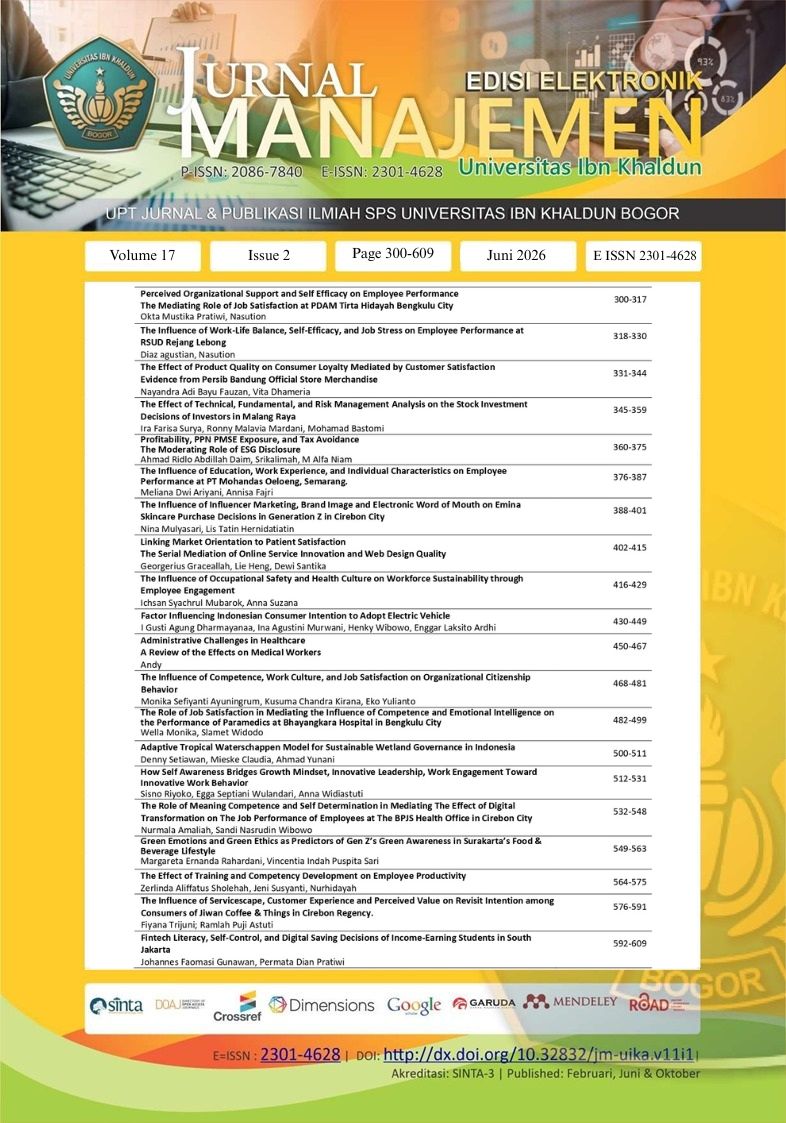
Profitability, PPN PMSE Exposure, and Tax Avoidance
The Moderating Role of ESG Disclosure
DOI:
https://doi.org/10.32832/jm-uika.v17i2.22157Keywords:
ESG integration,, TaxationAbstract
This syudy aims to analyse the influence of profitability and PPN PMSE exposure on tax avoidance, and to assess the moderating role of ESG disclosure among PPN PMSE collection companies registered with the Directorate General of Taxes (DJP). The sample comprises 17 companies from 2022 to 2024 (51 firm-year observations). Secondary data were collected from annual financial reports, GRI-based sustainability reports, and DJP documents, then analyzed using panel regression and moderated regression with the Moderated Regression Analysis (MRA) approach. The results indicate that: (i) profitability has no significant effect on tax avoidance; (ii) PPN PMSE exposure is also not significant; (iii) ESG disclosure has a significant negative effect on tax avoidance; however, (iv) ESG disclosure does not moderate the relationship between profitability or PPN PMSE exposure and tax avoidance. The findings suggest that transparency in sustainability reporting is associated with reduced tax aggressiveness, while PPN PMSE policy requires stronger oversight to influence fiscal behavior. This research contributes to understanding how environmental, social, and governance transparency can impact tax strategies, informing policymakers and corporate managers on the importance of disclosure practices
References
Angelina. 2025. “Does ESG Performance Influence Corporate Tax Avoidance? An Empirical
Analysis.” 3(4):1257–65.
Awliya, Malika. 2022. “Analisis Profitabilitas (Return on Asset (Roa) Dan Return on Equity (RoE) Pada PT Sido Muncul Tbk (Periode 2015-2018).” Journal of Economic Education 1(1):10–18.
Center, Katadata Insight. 2021. “Perilaku Keuangan Generasi Z Dan Y.” PT Katadata Indonesia (September):1–50.
Collins, Sean P., Alan Storrow, Dandan Liu, Cathy A. Jenkins, Karen F. Miller, Christy Kampe, and Javed Butler. 2021. “Analisis Variabel Moderating.” 167–86.
Dalimunthe. 2020. “The Effect of Corporate Governance on Tax Avoidance: Evidence from Indonesia.” Management & Economics Research Journal 2(4):66–85. doi: 10.48100/merj.v2i4.126.
Elamer, Ahmed A., Mounia Boulhaga, and Bassam A. Ibrahim. 2024. “Corporate Tax Avoidance and Firm Value: The Moderating Role of Environmental, Social, and Governance (ESG) Ratings.” Business Strategy and the Environment 33(7):7446–61. doi: 10.1002/bse.3881.
Gloria, and Prima Apriwenni. 2020. “Effective Tax Rate Dan Faktor -Faktor Yang Memengaruhi.” Jurnal Akuntansi 9(2):17–31. doi: 10.46806/ja.v9i2.759.
Hermawan, Sakti, Sudradjat Sudradjat, and Firdaus Amyar. 2021. “Pengaruh Profitabilitas, Leverage, Ukuran Perusahaan Terhadap Tax Avoidance Perusahaan Property Dan Real Estate.” Jurnal Ilmiah Akuntansi Kesatuan 9(2):359–72. doi: 10.37641/jiakes.v9i2.873.
Hidayat, Kadarisman, and Diana Zuhroh. 2023. “The Impact of Environmental, Social and Governance, Sustainable Financial Performance, Ownership Structure, and Composition of Company Directors on Tax Avoidance: Evidence from Indonesia.” International Journal of Energy Economics and Policy 13(6):311–20. doi: 10.32479/ijeep.14557.
Indri, Pratiwi Novia, Luk Luk Fuadah, Yunisvita. 2024. “The Influence Of Environmental, Social, And Governance (ESG) And Capital Intensity On Tax Avoidance In Public Companies Listed On The Indonesian Stock Exchange (IDX).” 5(2):7772–83.
Mahpudin, Endang. 2024. “Digital Tax Reform in Indonesia: Perspective on Tax Policy Development.” Journal of Infrastructure, Policy and Development 8(8):1–17. doi: 10.24294/jipd.v8i8.7032.
Mutia, Devina Kansa. 2025. “Analisis Kecukupan Pojk 51/2017 Sebagai Kerangka Regulasi Pelaporan Esg Pada Emiten Sektor Keuangan Indonesia.” Jurnal Aktual Akuntansi Bisnis Terapan 8(1):104–24.
Noti, Giverly, Marthinus Ismail, and Mila Susanti. 2025. “Pengaruh Penerapan Green Accounting Dan Perencanaan Pajak Terhadap Kinerja Keuangan Sektor Energi Yang Terdaftar Di BEI (2021-2023).” Journal Of Business, Economics, And Finance 3(1):128–40.
Ortas, Eduardo, and Isabel Gallego-Álvarez. 2020. “Bridging the Gap between Corporate Social Responsibility Performance and Tax Aggressiveness: The Moderating Role of National Culture.” Accounting, Auditing and Accountability Journal 33(4):825–55. doi: 10.1108/AAAJ-03-2017-2896.
Pajak, Direktorat Jenderal. 2023. “Penerimaan PPN PMSE.” Pajak.Go.Id.
Prang. 2024. “Pengaruh Profitabilitas Dan Ukuran Perusahaan Terhadap Tax Avoidance Pada Perusahaan Manufaktur Yang Terdaftar Di Bursa Efek Indonesia.” Manajemen Bisnis Dan Keuangan Korporat 2(1):42–51. doi: 10.58784/mbkk.100.
Pratiwi, Kadek Dhea. 2025. “Analisis Penerapan Ppn Atas Perdagangan Melalui Sistem Elektronik ( Pmse ) Sebagai Upaya Optimalisasi Penerimaan Pajak Halaman Sampul Depan Nama Nim : Kadek Dhea Pratiwi Analisis Penerapan Ppn Atas Perdagangan Melalui Sistem Elektronik ( PMSE ).”
Puncak Joyontono, 1)Subarno, 1)Reineta Puspitasari, 1)Tiara Handayani, 1)Asal Izmi, 1)Cut Ayu Tiara S, 1)M. Rifki Ghozali, 1)Ika Indah Karlina, 1)Muhammad Fitranata N, 2)Suprapto Dibyosaputro. 1967. Statistik Multivariat Dalam Riset.
Putra, Oky Julio. 2024. “Value Added Tax: A Suitable Alternative for Taxing The Digital Economy? (Indonesian Context).” JURNAL PAJAK INDONESIA (Indonesian Tax Review) 8(1):184–202. doi: 10.31092/jpi.v8i1.2775.
Rahayu, Linda, Riri Zelmiyanti, Afriyanti Hasanah, Politeknik Negeri Batam, Aifa Izzwatul Hikmah, Zuraidah Zuraidah, Diena Fukuyama Indah, Sri Dewi Wahyuni, Nurfika Anggraini, Kusnul Sahara, Citra Widiapsarinim, Ardi Hamzah, Febrian Suryanto, and Lia Dama Yanti. 2024. “Korelasi Antara Kinerja Keuangan Dan Kebijakan Pajak Agresif.” ECo-Sync: Economy Synchronization 1(01):144–
62. doi: 10.24967/jaeap.v4i01.3933.
Saputra, Prasetyo. 2025. “LITERA: Jurnal Literasi Akuntansi Vol. 5 No. 1 Maret 2025.” 5(1):12–26.
Setyaningsih, Fitri, Tutty Nuryati, Elia Rossa, and Nera Marinda Machdar. 2023. “Pengaruh Profitabilitas, Leverage, Dan Capital Intensity Terhadap Tax Avoidance.” SINOMIKA Journal: Publikasi Ilmiah Bidang Ekonomi Dan Akuntansi 2(1):35–44. doi: 10.54443/sinomika.v2i1.983.
Sihaloho, Ulfah Oktarida. 2025. “Challenges and Strategic Approaches in Digital Vat Collection: Evidence From Indonesian E-Commerce Sector.” Kajian Ilmiah Mahasiswa Administrasi Publik (KIMAP) 6(1):1–16. doi: 10.26618/kimap.v6i1.17426.
Sugimin. 2024. “Jurnal Konsep Bisnis Dan Manajemen.” Jurnal Konsep Bisnis Dan Manajemen 3(1):32–43. doi: 10.31289/jkbm.v10i2.11732.
Sugiyono. 2020. Metodologi Penelitian Kuantitatif, Kualitatif Dan R & D.
Tambunan, Maria R. U. D. 2019. “Transformasi Budaya Organisasi Otoritas Perpajakan Indonesia Menghadapi Era Ekonomi Digital.” 5(2):253–64.
Teja, Adrian. 2024. “Environmental, Social and Governance Disclosure Scores and Tax Avoidance.” Jurnal Ilmiah Akuntansi 9(1):186–209. doi: 10.23887/jia.v9i1.69573.
Widiastutik, Rika Nur, Syaiful Iqbal, and Mohamad Khoiru Rusydi. 2024. “Moderating Role of ESG Disclosure on Minority Shareholders and Tax Avoidance.” Journal of Accounting Research, Organization and Economics 7(2):237–52. doi: 10.24815/jaroe.v7i2.37155.
Wulandari, Destiny. 2023. “Tentang PPN PMSE Indonesia: Masih Ada Yang Perlu Diperbaiki?” JURNAL PAJAK INDONESIA (Indonesian Tax Review) 7(2):54–66. doi: 10.31092/jpi.v7i2.2494.
Yanti, Ni Ketut Irna Alfina, Made Arie Wahyuni. 2025. “Pengaruh Profitabilitas , Leverage , Dan Ukuran Perusahaan Terhadap Tax Avoidance ( Studi Kasus Pada Perusahaan Sektor Properti Dan Real Estate.” 14(1):123–33.
Downloads
Published
How to Cite
Issue
Section
License
Copyright (c) 2026 Jurnal Manajemen

This work is licensed under a Creative Commons Attribution-NonCommercial 4.0 International License.
Authors who publish with this journal agree to the following terms:
- Authors retain copyright and grant the journal right of first publication with the work simultaneously licensed under a Creative Commons Attribution-NonCommercial-ShareAlike 4.0 International License that allows others to share the work with an acknowledgement of the work's authorship and initial publication in this journal.
- Authors can enter into separate, additional contractual arrangements for the non-exclusive distribution of the journal's published version of the work (e.g., post it to an institutional repository or publish it in a book), with an acknowledgement of its initial publication in this journal.
- Authors are permitted and encouraged to post their work online (e.g., in institutional repositories or on their website) prior to and during the submission process, as it can lead to productive exchanges, as well as earlier and greater citation of published work (See The Effect of Open Access).