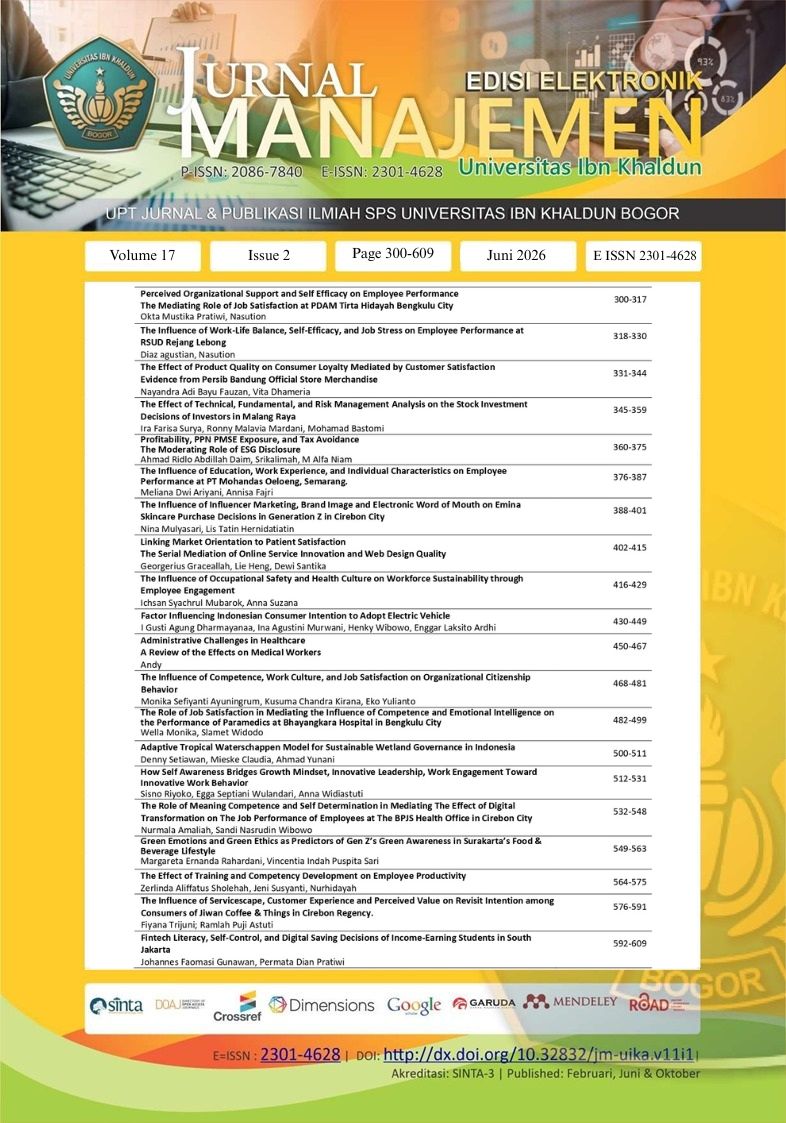
The Influence of Occupational Safety and Health Culture on Workforce Sustainability through Employee Engagement
DOI:
https://doi.org/10.32832/jm-uika.v17i2.22886Keywords:
Occupational safety and health culture, Employee engagement, Workforce sustainabilityAbstract
This study examines the effect of occupational safety and health (OSH) culture on workforce sustainability, with employee involvement as a mediating variable at SPPBE Adam Pramudya. Preliminary findings indicate the presence of occupational risks and varying levels of employee involvement that may affect workforce sustainability, highlighting the need for an OSH culture that encourages active employee participation. This research adopts a quantitative approach using a survey of 100 employees. Data were collected through a structured questionnaire that met validity and reliability requirements and were analyzed using Partial Least Squares–Structural Equation Modeling (PLS-SEM) with SmartPLS 4.0. The results show that OSH culture has a positive and significant effect on employee involvement and workforce sustainability. Employee involvement also significantly influences workforce sustainability and mediates the relationship between OSH culture and workforce sustainability. These findings emphasize the importance of strengthening OSH culture through enhanced employee involvement to ensure sustainable workforce management.
References
Al-Oun, S. (2025). Sustainable human resource management and career quality: Evidence from the electricity distribution sector. Sustainability, 17(11), 4866. https://doi.org/10.3390/su17114866
Amalia, I. W. N., & Salmira, C. S. (2025). Pengaruh budaya keselamatan dan kesehatan kerja terhadap unsafe action pekerja. Jurnal Pengabdian Masyarakat Dan Riset Pendidikan, 4(1), 3140–3143. https://doi.org/10.31004/jerkin.v4i1.2108
Andriany, R. A. R., Hardy, H., Asrul, A., Maslim, M., & Megawaty, M. (2025). Evaluation of the sustainability of organizational welfare and human resources to improving long-term performance. Paradoks: Jurnal Ilmu Ekonomi, 8(2), 540–555. https://doi.org/10.57178/paradoks.v8i2.1157
Astuti, P. N., Djunaidi, Z., & Alfiyyah, A. (2025). Evaluating safety culture maturity in Indonesian petrochemical industry to strengthen occupational health systems. Media Publikasi Promosi Kesehatan Indonesia, 8(8), 595–608. https://doi.org/10.56338/mppki.v8i8.7393
Buulolo, A., Waruwu, E., & Halawa, F. (2025). Implementasi Sustainable Human Resource Management dalam mewujudkan keberlanjutan organisasi. Jurnal Ekonomi (LIKUID), 1(03), 168–176. https://doi.org/10.70404/likuid.v1i03.507
Cahyadi, L., Resnandi Raka, R., & Utami, V. L. (2025). Sustainable human resource management impact on work engagement, employability, and job satisfaction at an Indonesian state-owned construction company. Kinerja, 29(2), 204–215. https://doi.org/10.24002/kinerja.v29i2.11457
Claxton, G., Hosie, P., & Sharma, P. (2022). Toward an effective occupational health and safety culture: A multiple stakeholder perspective. Journal of Safety Research, 82, 57–67. https://doi.org/10.1016/j.jsr.2022.04.006
Creswell, J. W., & Creswell, J. D. (2022). Research Design: Qualitative, Quantitative, and Mixed Methods Approaches (6th ed.). SAGE Publications.
Dzakwan, A. A., Jihan Rahma Alfiyyah, Afifa, S., Muhammad, Ken, & Adhani, D. W. (2025). Students’ understanding of occupational safety and health culture. Jurnal Pendidikan Teknik Bangunan, 5(2), 45–54. https://ejournal.upi.edu/index.php/JPTB/article/view/88937
Gupta, V., & Sharma, M. (2023). Employee engagement and turnover intention: A meta-analytic review. International Journal of Human Resource Management, 34(18), 3541–3564. https://doi.org/10.1080/09585192.2023.2189567
Hair, J. F., Hult, G. T. M., Ringle, C. M., Sarstedt, M., Danks, N. P., & Ray, S. (2021). Partial Least Squares Structural Equation Modeling (PLS-SEM) Using R: A Workbook. Springer. https://doi.org/10.1007/978-3-030-80519-7
Handayani, H. R. (2023). Implementation of occupational health and safety communication in petrochemical industry. Asian Journal of Management, Entrepreneurship and Social Science, 3(2), 521–536.
Ismail, S. N., Ramli, A., & Prasetya, T. A. E. (2024). The important role of safety culture in management of major industrial accidents. The Indonesian Journal of Occupational Safety and Health, 13(2), 252–260. https://doi.org/10.20473/ijosh.v13i2.2024.252-260
Kabiesz, P., & Tutak, M. (2024). Developing a culture of safety for sustainable development and public health in manufacturing companies: A case study. Sustainability, 16(17), 7557. https://doi.org/10.3390/su16177557
Kim, W., Han, S. J., & Park, J. (2024). Employee engagement and job performance: The mediating role of organizational commitment. Sustainability, 16(5), 2143. https://doi.org/10.3390/su16052143
Madero-Gómez, S. M., Rubio Leal, Y. L., Olivas-Luján, M., & Yusliza, M. Y. (2023). Companies could benefit when they focus on employee wellbeing and the environment: A systematic review of sustainable human resource management. Sustainability, 15(6), 5435. https://doi.org/10.3390/su15065435
Mushtaq, S., & Akhtar, S. (2024). Sustainable HRM strategies enhancing organizational resilience and advancing sustainability goals. Journal of Management Development, 43(5), 712–726. https://doi.org/10.1108/JMD-02-2024-0072
Pradana, S. R., Zulfikar, I., & Ramdan, M. (2025). Hubungan budaya keselamatan dan kesehatan kerja terhadap perilaku aman pekerja. Identifikasi, 11(4), 1029–1039. https://doi.org/10.36277/identifikasi.v11i4.771
Pratiwi, R., & Nugroho, R. S. (2025). Pengaruh kepemimpinan dan lingkungan kerja terhadap keterlibatan karyawan. Jurnal Manajemen Dan Bisnis Indonesia, 12(1), 45–58. https://doi.org/10.31843/jmbi.v12i1.456
Rahman, M. M., Ali, N. A., & Mamun, A. A. (2024). Transformational leadership and employee engagement: Evidence from emerging economies. Heliyon, 10(2), e23511. https://doi.org/10.1016/j.heliyon.2024.e23511
Saks, A. M. (2023). Antecedents and consequences of employee engagement revisited. Journal of Organizational Effectiveness: People and Performance, 10(3), 410–427. https://doi.org/10.1108/JOEPP-01-2023-0011
Soni, R. I., Yuliana, L., & Zulfikar, I. (2025). Penerapan budaya keselamatan dan kesehatan kerja pada kegiatan operasional workshop. Identifikasi, 11(3), 698–705. https://doi.org/10.36277/identifikasi.v11i3.716
Suryani, E., & Wibowo, A. (2025). Keterlibatan karyawan sebagai mediator antara kepuasan kerja dan kinerja karyawan. Jurnal Ilmu Manajemen, 13(2), 189–201. https://doi.org/10.26740/jim.v13n2.p189-201
Tarigan, A. S., & Susilawati. (2023). Hubungan safety culture dengan perilaku kesehatan dan keselamatan kerja. Arrazi: Scientific Journal of Health, 1(2), 115–123. https://journal.csspublishing.com/index.php/arrazi/article/view/270
Waruwu, Y., Halawa, F., & Waruwu, E. (2025). Sustainable HRM sebagai dasar pengembangan praktik HR yang berkelanjutan. Jurnal Ekonomi (LIKUID), 1(03), 135–141. https://doi.org/10.70404/likuid.v1i03.491
Widiyati, D., Jakaria, J., Gunawan, J., Gow, I. S., Sihombing, T. E., Utami, G. M. W., & Mulyadini, D. (2025). Greening city: Opportunities and challenges in workforce development for a sustainable economy. Jurnal Ketenagakerjaan, 20(1), 457. https://doi.org/10.47198/jnaker.v20i1.457
Widodo, S. E., & Handoko, T. H. (2026). Digital leadership and employee engagement in the post-pandemic workplace. Human Resource Management Review, 36(1), 100948. https://doi.org/10.1016/j.hrmr.2025.100948
Yulistria, R., Sundara, W. C., Marsusanti, E., & Yanti, V. A. (2025). Green human resource management: Integrating sustainability into talent development and retention. Jurnal Manajemen, Bisnis Dan Kewirausahaan, 5(3), 689–700. https://doi.org/10.55606/jumbiku.v5i3.6225
Downloads
Published
How to Cite
Issue
Section
License
Copyright (c) 2026 Jurnal Manajemen

This work is licensed under a Creative Commons Attribution-NonCommercial 4.0 International License.
Authors who publish with this journal agree to the following terms:
- Authors retain copyright and grant the journal right of first publication with the work simultaneously licensed under a Creative Commons Attribution-NonCommercial-ShareAlike 4.0 International License that allows others to share the work with an acknowledgement of the work's authorship and initial publication in this journal.
- Authors can enter into separate, additional contractual arrangements for the non-exclusive distribution of the journal's published version of the work (e.g., post it to an institutional repository or publish it in a book), with an acknowledgement of its initial publication in this journal.
- Authors are permitted and encouraged to post their work online (e.g., in institutional repositories or on their website) prior to and during the submission process, as it can lead to productive exchanges, as well as earlier and greater citation of published work (See The Effect of Open Access).