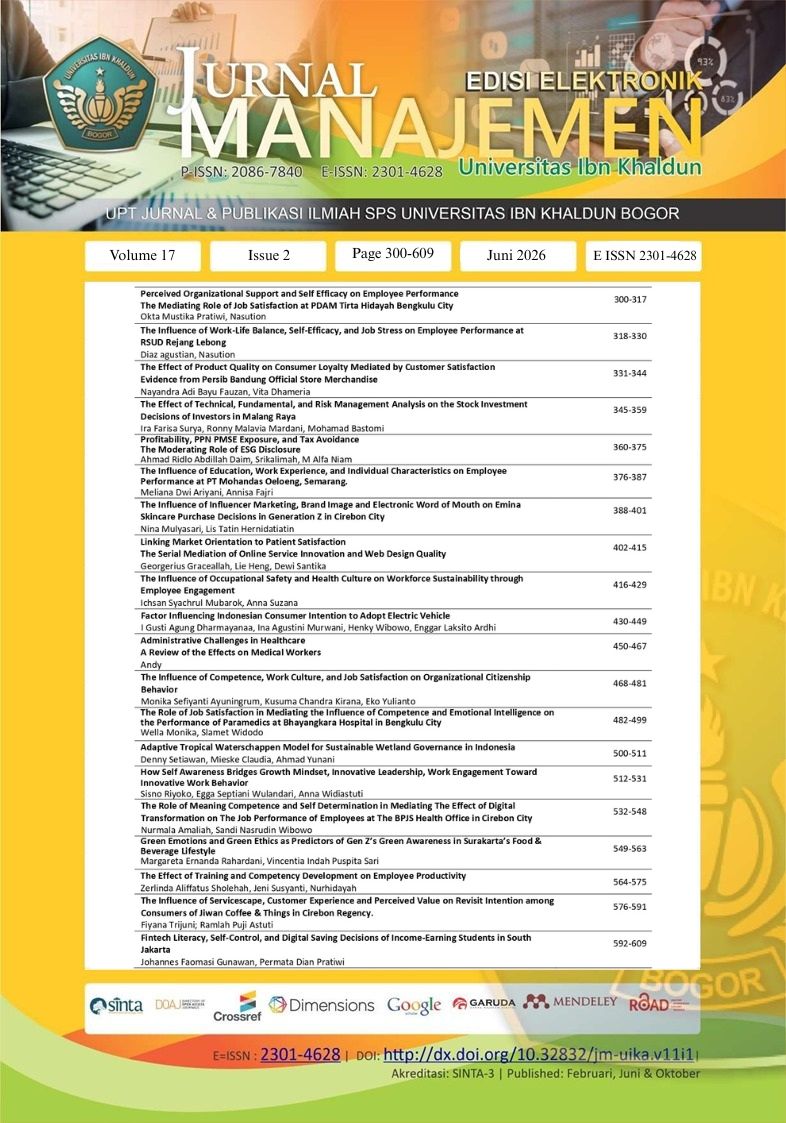
The Role of Meaning Competence and Self Determination in Mediating The Effect of Digital Transformation on The Job Performance of Employees at The BPJS Health Office in Cirebon City
DOI:
https://doi.org/10.32832/jm-uika.v17i2.23118Keywords:
Digital Transformation, Job Performance, Meaning Competence, Self-Determination.Abstract
Digital transformation has become a crucial factor in improving employee performance; however, its success is not only determined by technological aspects, but also by the psychological readiness of employees. This study aims to analyze the effect of digital transformation on work performance, with meaning competence and self-autonomy as mediating variables among employees of the Cirebon BPJS Health Office. This study employs a quantitative approach using an associative research design to analyse the relationships among variables a saturated sampling technique involving 109 respondents. Data were collected through questionnaires and analyzed using Structural Equation Modeling–Partial Least Squares (SEM-PLS) with SmartPLS software. The results show that digital transformation has a significant positive effect on work performance, meaningfulness, and self-autonomy. In addition, meaningful competence and self-autonomy significantly influence work performance. Mediation analysis shows that digital transformation acts as a mediator in the relationship between meaningful competence and autonomy and work performance. These findings highlight that the success of digital transformation in improving work performance is greatly influenced by employees' the ability to find meaning in their work (meaning competence) and their level of autonomy and intrinsic motivation (self-determination).
References
Abhari, K. (2025). Employee Participation in Digital Transformation: From Digitalization Sentiment to Transformation Predisposition. Information and Management, 62(8). https://doi.org/10.1016/j.im.2025.104212
Al-Alawi, A. I., Messaadia, M., Mehrotra, A., Sanosi, S. K., Elias, H., & Althawadi, A. H. (2023). Digital transformation adoption in human resources management during COVID-19. Arab Gulf Journal of Scientific Research, 41(4), 446–461. https://doi.org/10.1108/AGJSR-05-2022-0069
Alonso, M. L., García, C., & Gabriela, A. (2024). A meta ‑ analysis of psychological empowerment : Antecedents , organizational outcomes , and moderating variables. Current Psychology, 43(2), 1759–1784. https://doi.org/10.1007/s12144-023-04369-8
Astuti, D. P., Wiguna, W., & Suparmoko, M. (2025). The Influence of Digital Transformation and Work Environment on Employee Performance through Motivation as an Intervening Variable in the Human Resources Development and Personnel Agency ( Lebak Regency , Serang City and Cilegon City ). 1279–1292.
Bindel Sibassaha, J. L., Pea-Assounga, J. B. B., & Bambi, P. D. R. (2025). Influence of digital transformation on employee innovative behavior: roles of challenging appraisal, organizational culture support, and transformational leadership style. Frontiers in Psychology, 16(March), 1–18. https://doi.org/10.3389/fpsyg.2025.1532977
Blanka, C., Krumay, B., & Rueckel, D. (2022). Technological Forecasting & Social Change The interplay of digital transformation and employee competency : A design science approach. Technological Forecasting & Social Change, 178(December 2021), 121575. https://doi.org/10.1016/j.techfore.2022.121575
Cosa, M., & Torelli, R. (2024). Digital Transformation and Flexible Performance Management: A Systematic Literature Review of the Evolution of Performance Measurement Systems. Global Journal of Flexible Systems Management, 25(3), 445–466. https://doi.org/10.1007/s40171-024-00409-9
Gao, P., & Gao, Y. (2024). How Does Digital Leadership Foster Employee Innovative Behavior: A Cognitive–Affective Processing System Perspective. Behavioral Sciences, 14(5). https://doi.org/10.3390/bs14050362
Gun, L., Imamoglu, S. Z., Turkcan, H., & Ince, H. (2024). Effect of Digital Transformation on Firm Performance in the Uncertain Environment: Transformational Leadership and Employee Self-Efficacy as Antecedents of Digital Transformation. Sustainability (Switzerland), 16(3). https://doi.org/10.3390/su16031200
Hizam, S. M., Akter, H., Sentosa, I., Ahmed, W., Masrek, M. N., & Ali, J. (2023). Predicting Workforce Engagement towards Digital Transformation through a Multi-Analytical Approach. Sustainability (Switzerland), 15(8). https://doi.org/10.3390/su15086835
Hu, D., & Lan, Y. (2024). The dual path effect mechanism study of digital-HRM on employee innovative performance and cyberloafing. In PLoS ONE (Vol. 19, Issue 8 August). https://doi.org/10.1371/journal.pone.0307195
Hwang, I., Shim, H., & Lee, W. J. (2022). Do an Organization’s Digital Transformation and Employees’ Digital Competence Catalyze the Use of Telepresence? Sustainability (Switzerland), 14(14). https://doi.org/10.3390/su14148604
Lestari, D., Hartono, E., & Wibowo, S. N. (2022). Pengaruh Kompensasi dan Motivasi Kerja Terhadap Kinerja Karyawan Pada PT. Pabrik Gula Rajawali II Tersana Baru. JIMF (Jurnal Ilmiah Manajemen Forkamma), 5(2), 151. https://doi.org/10.32493/frkm.v5i2.12603
Lysova, E. I., Allan, B. A., Dik, B. J., Duffy, R. D., & Steger, M. F. (2019). Fostering meaningful work in organizations: A multi-level review and integration. Journal of Vocational Behavior, 110, 374–389. https://doi.org/10.1016/j.jvb.2018.07.004
Maghrifani, D., Fadli, A. O., & Ardekani, A. M. (2022). Workplace digital transformation: Impact of employees’ autonomy and relatedness to employees’ intention actively support digital transformation. Sebelas Maret Business Review, 7(2), 101. https://doi.org/10.20961/smbr.v7i2.73472
Muneer, S., Singh, A., Choudhary, M. H., & Alshammari, A. S. (2025). The Mediating Role of Psychological Empowerment on the Relationship Between Digital Transformation, Innovative Work Behavior, and Organizational Financial Performance. Behavioral Sciences, 15(1). https://doi.org/10.3390/bs15010005
Nie, T., Tian, M., Cai, M., & Yan, Q. (2023). Job Autonomy and Work Meaning: Drivers of Employee Job-Crafting Behaviors in the VUCA Times. Behavioral Sciences, 13(6). https://doi.org/10.3390/bs13060493
Ochoa Pacheco, P., Coello-Montecel, D., & Tello, M. (2023). Psychological Empowerment and Job Performance: Examining Serial Mediation Effects of Self-Efficacy and Affective Commitment. Administrative Sciences, 13(3). https://doi.org/10.3390/admsci13030076
Qiao, G., Li, Y., & Hong, A. (2024). The Strategic Role of Digital Transformation: Leveraging Digital Leadership to Enhance Employee Performance and Organizational Commitment in the Digital Era. Systems, 12(11). https://doi.org/10.3390/systems12110457
Seo, J. (2023). Why Does the Impact of Psychological Empowerment Increase Employees’ Knowledge-Sharing Intention? A Moderated Mediation Model of Belonging and Perceived Organizational Support. Behavioral Sciences, 13(5). https://doi.org/10.3390/bs13050387
Shie, A. J., Xu, E. M., Li, H., Yang, G., & Huang, Y. F. (2025). The impact of platform leadership on employee deviant innovation in digital transformation enterprises. Scientific Reports, 15(1), 1–14. https://doi.org/10.1038/s41598-025-86208-3
Sipe, L. J. (2018). Connect, Refresh, and Energize: Enabling Organizational Innovation Capacities Through Self-Determination Theory. Advances in Developing Human Resources, 20(2), 241–253. https://doi.org/10.1177/1523422318756637
Starke, S., & Ludviga, I. (2025). Unlocking Digital Potential—The Impact of Innovation and Self-Determined Learning. Systems, 13(5), 1–17. https://doi.org/10.3390/systems13050396
Sugiyono. (2023). Metode Penelitian Kuantitatif, Kualitatif, dan R&D. Alfabeta.
Ullrich, A., Reißig, M., Niehoff, S., & Beier, G. (2023). Employee involvement and participation in digital transformation: a combined analysis of literature and practitioners’ expertise. Journal of Organizational Change Management, 36(8), 29–48. https://doi.org/10.1108/JOCM-10-2022-0302
Verhoef, P. C., Broekhuizen, T., Bart, Y., Bhattacharya, A., Qi Dong, J., Fabian, N., & Haenlein, M. (2021). Digital transformation: A multidisciplinary reflection and research agenda. Journal of Business Research, 122(September 2019), 889–901. https://doi.org/10.1016/j.jbusres.2019.09.022
Wibowo, S. N. (2018). PENGARUH REKRUTMEN DAN PENEMPATAN PEGAWAI TERHADAP KINERJA PEGAWAI (Studi pada PT. Bank Syariah Mandiri Cabang A. Yani Bandung). Monex Journal Research Accounting Politeknik Tegal, 7(1). https://doi.org/10.30591/monex.v7i1.754
Yildiz, K., Akoğlu, H. E., Emir, E., Angosto, S., & García-Fernández, J. (2025). The perceived effect of digital transformation and resultant empowerment on job performance of employees in the fitness family business. Journal of Family Business Management, 15(1), 102–121. https://doi.org/10.1108/JFBM-02-2024-0038
Downloads
Published
How to Cite
Issue
Section
License
Copyright (c) 2026 Jurnal Manajemen

This work is licensed under a Creative Commons Attribution-NonCommercial 4.0 International License.
Authors who publish with this journal agree to the following terms:
- Authors retain copyright and grant the journal right of first publication with the work simultaneously licensed under a Creative Commons Attribution-NonCommercial-ShareAlike 4.0 International License that allows others to share the work with an acknowledgement of the work's authorship and initial publication in this journal.
- Authors can enter into separate, additional contractual arrangements for the non-exclusive distribution of the journal's published version of the work (e.g., post it to an institutional repository or publish it in a book), with an acknowledgement of its initial publication in this journal.
- Authors are permitted and encouraged to post their work online (e.g., in institutional repositories or on their website) prior to and during the submission process, as it can lead to productive exchanges, as well as earlier and greater citation of published work (See The Effect of Open Access).