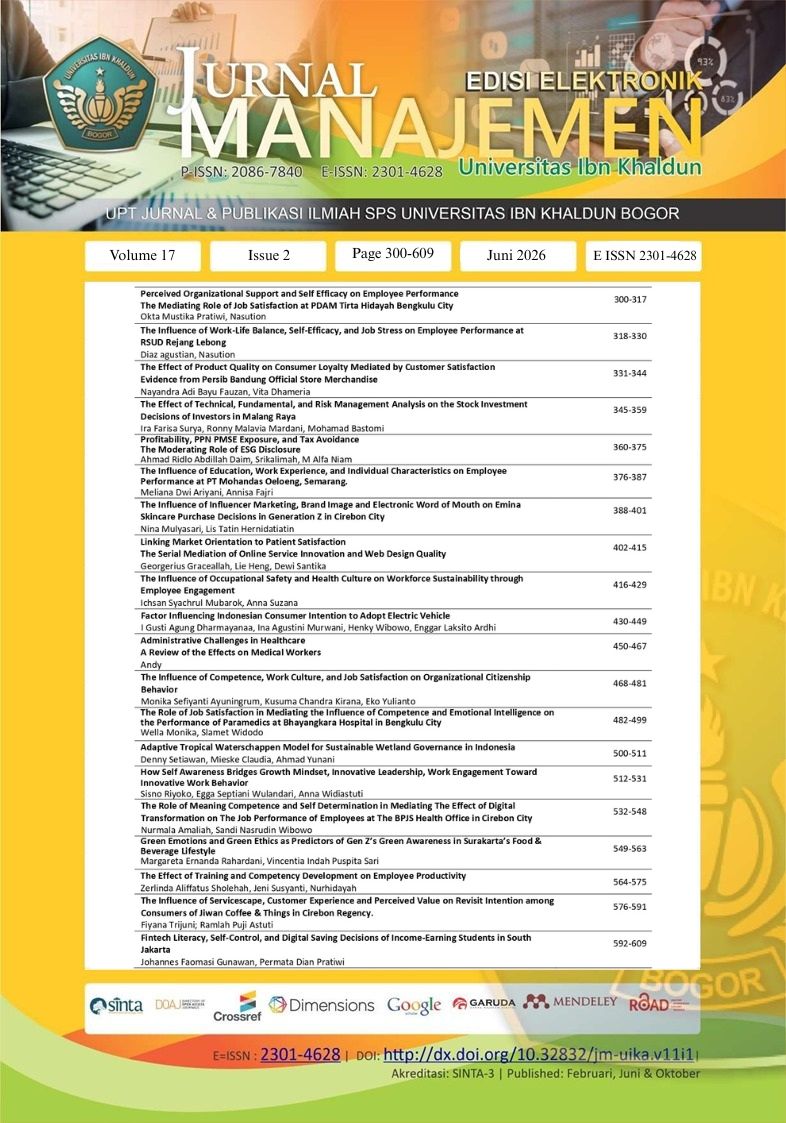
The Role of Job Satisfaction in Mediating the Influence of Competence and Emotional Intelligence on the Performance of Paramedics at Bhayangkara Hospital in Bengkulu City
DOI:
https://doi.org/10.32832/jm-uika.v17i2.23378Keywords:
kinerja, Kompetensi, kecerdasan emosional, dan Kepuasan kerja.Abstract
This study uses job satisfaction as a mediating variable to examine how competence and emotional intelligence affect paramedics' performance at Bengkulu City's Bhayangkara Hospital. A saturation sampling strategy was used to choose a sample of 201 respondents for the quantitative study. Questionnaires were used to gather data, and SmartPLS version 3.2 was used for analysis.Nine. According to the study's findings, paramedic performance is positively and significantly impacted by competence and emotional intelligence, both directly and through job satisfaction. At Bengkulu City's Bhayangkara Hospital, it has been demonstrated that job satisfaction is a significant mediating element that enhances the impact of competence and emotional intelligence on paramedic performance. This study provides insights for hospital management and policymakers to design more effective human resource management strategies in improving paramedic performance through strengthening competence, emotional intelligence, and job satisfaction.
References
Abi, A. R. (2019). Kecerdasan emosional dalam kepemimpinan pendidikan. SOTIRIA (Jurnal Theologia dan Pendidikan Agama Kristen), 2(1), 60-68. https://doi.org/10.47166/sot.v2i1.5
Abusama, M., Haming, M., Nasir Hamzah, M., & Author, C. (2017). Effect of motivation, competence and Islamic leadership on job satisfaction and Teacher performance in vocational high school. 19, 1–12. https://doi.org/10.9790/487X-1910050112
Alghamdi, M. G., Ur Rahman, S., & Berhanu, D. (2018). Job satisfaction and performance among healthcare workers in Saudi Arabia. Journal of Taibah University Medical Sciences, 13(4), 340–346. https://doi.org/10.1016/j.jtumed.2018.05.003
Becker, G. S. (1964). Human Capital New York. Columbia University for the National Bureau of Economic Research.
Codier, E., Kamikawa, C., & Kooker, B. M. (2011). The impact of emotional intelligence development on nurse managers. Nursing Administration Quarterly, 35(3), 270–276. https://doi.org/10.1097/NAQ.0b013e3182243ae3
Côté, S. (2014). Emotional Intelligence in Organizations. In Annual Review of Organizational Psychology and Organizational Behavior (Vol. 1, pp. 459–488). Annual Reviews Inc. https://doi.org/10.1146/annurev-orgpsych-031413-091233
Ghozali, I., & Latan, H. (2015). Konsep, teknik, aplikasi menggunakan Smart PLS 3.0 untuk penelitian empiris. BP Undip. Semarang, 290.
Goleman, D. (2005). Emotional intelligence: Why it can matter more than IQ. Bantam.
Gondal, U. H., & Husain, T. (2013). A Comparative Study of Intelligence Quotient and Emotional Intelligence: Effect on Employees’ Performance. Asian Journal of Business Management, 5(1), 153–162. https://doi.org/10.19026/ajbm.5.5824
Hair, J. F. (2010). Black, Wc, Babin, Bj, & Anderson, Re (2010). Multivariate data analysis, 7, 77-95.
Hair, J. F., Hult, G. T. M., Ringle, C. M., Sarstedt, M., & Thiele, K. O. (2017). Mirror, mirror on the wall: a comparative evaluation of composite-based structural equation modeling methods. Journal of the Academy of Marketing Science, 45(5), 616–632. https://doi.org/10.1007/s11747-017-0517-x
Herzberg, F. (1966). Work and the Nature of Man. World Publishing Company.
Ilham, I. (2024). MANAJEMEN SUMBER DAYA MANUSIA. In M. G. Efgivia (Ed.), CV WIDINA MEDIA UTAMA.
Indrasari, M. (2017). Kepuasan Kerja dan Kinerja Karyawan Tinjauan dari Dimensi Iklim Organisasi, Kreativitas Individu, dan Karakteristik Pekerjaan (1st ed.). Indomedia Pustaka.
Indrawan, R., & Yaniawati, R. P. (2016). Metodologi penelitian: Kuantitatif, kualitatif dan campuran untuk manajemen, pembangunan, dan pendidikan.
Irawan, H., & Bagyo, Y. (2022). Pengaruh Organizational Culture, Emotional Intelligence, dan Social Intelligence Terhadap Employee Engagement:(Studi pada Pegawai Bagian Non-Medis RSU Universitas Muhammadiyah Malang). Bisman (Bisnis Dan Manajemen): The Journal of Business and Management, 5(3), 366–386.
Joseph, D. L., Jin, J., Newman, D. A., & O’Boyle, E. H. (2015). Why does self-reported emotional intelligence predict job performance? A meta-analytic investigation of mixed EI. Journal of Applied Psychology, 100(2), 298–342. https://doi.org/10.1037/a0037681
Karimi, L., Leggat, S. G., Donohue, L., Farrell, G., & Couper, G. E. (2014). Emotional rescue: The role of emotional intelligence and emotional labour on well-being and job-stress among community nurses. Journal of Advanced Nursing, 70(1), 176–186. https://doi.org/10.1111/jan.12185
Kim, S. J., & Choi, S. O. (2018). The effects of job mismatch on pay, job satisfaction, and performance. Journal of Open Innovation: Technology, Market, and Complexity, 4(4). https://doi.org/10.3390/joitmc4040049
Kolibácová, G. (2014). The relationship between competency and performance. Acta Universitatis Agriculturae et Silviculturae Mendelianae Brunensis, 62(6), 1315–1327. https://doi.org/10.11118/actaun201462061315
Locke, E. A. (1976). The nature and causes of job satisfaction. Handbook of Industrial and Organizational Psychology.
Luthans, F., Youssef-Morgan, C. M., & Avolio, B. J. (2015). Psychological capital and beyond. Oxford university press.
Marliani, R., Nasrudin, E., Rahmawati, R., & Ramdani, Z. (2020). Regulasi emosi, stres, dan kesejahteraan psikologis: Studi pada ibu work from home dalam menghadapi pandemi COVID-19. Karya Tulis Ilmiah LP2M UIN SGD Bandung.
Miao, C., Humphrey, R. H., & Qian, S. (2017). A meta-analysis of emotional intelligence and work attitudes. Journal of Occupational and Organizational Psychology, 90(2), 177–202. https://doi.org/10.1111/joop.12167
Naz, S., Li, C., Khan, H. S. U. D., & Rafiq, M. (2019). The impact of emotional intelligence on employee performance and employee engagement: mediating role of job satisfaction. Middle East Journal of Management, 6(5), 574-596. https://doi.org/10.1504/MEJM.2019.101921
Noe, R. A.., Hollenbeck, J. R.., Gerhart, B. A.., & Wright, P. M. (2017). Human resource management: gaining a competitive advantage. McGraw-Hill Education.
Noviantoro, D., & Sakarina, S. (2026). The Effect of Work Stress and Emotional Intelligence on Job Satisfaction and Its Impact on The Performance of Nurses At Palembang Bari Regional General Hospital. In Southeast Asia Journal of Islamic Business and Economics Graduates (SAJGIBE), 5(1), 13-22. https://doi.org/10.37567/sajgibe.v5i1.5111
Oppong, R. F., & Zhau, W. (2020). The Influence of Competence on Performance with Motivation as An Intervening Variable on Medical Employees in America Public Service Department. Medalion Journal: Medical Research, Nursing, Health and Midwife Participation, 1(2), 63-70. https://doi.org/10.59733/medalion.v1i2.44
Pramularso, E. Y. (2018). Pengaruh Kompetensi terhadap Kinerja Karyawan CV Inaura Anugerah Jakarta. Widya Cipta: Jurnal Sekretari dan Manajemen, 2(1), 40-46. https://doi.org/10.31294/widyacipta.v2i1.2803
Pratiwi, N. P., & Ali, H. (2023). Pengaruh gaya kepemimpinan, pelatihan, dan stres kerja pada kinerja pegawai rumah sakit di era digital. Jurnal Ilmu Manajemen Terapan (JIMT), 5(2), 1–10. https://doi.org/10.31933/jemsi.
Purba, D. C., Lengkong, V. P. K., & Loindong, S. (2019). Analisis Pengaruh Kepuasan Kerja, Motivasi Kerja dan Disiplin Kerja Terhadap Kinerja Pegawai pada Perusahaan Umum Percetakan Negara Republik Indonesia Cabang Manado. Jurnal EMBA: Jurnal Riset Ekonomi, Manajemen, Bisnis Dan Akuntansi, 7(1), 841–850. https://doi.org/10.35794/emba.7.1.2019.22911
Rahmawati, N., & Hakim, A. (2021). The effect of competence and work environment on performance mediated by job satisfaction among health workers. Jurnal Kesehatan Masyarakat, 17(2), 215–226. https://doi.org/10.15294/kemas.v17i2.27154
Rahmawati, P. (2024). Pengaruh Workplace Resilience, Perceived Organizational Support, dan Emotional Intelligence Terhadap Psychological Well-Being Perawat Rumah Sakit Jiwa. Universitas Islam Negeri Syarif Hidayatullah.
Raziq, A., & Maulabakhsh, R. (2015). Impact of Working Environment on Job Satisfaction. Procedia Economics and Finance, 23, 717–725. https://doi.org/10.1016/s2212-5671(15)00524-9
Renyut, B. C., Modding, H. B., Bima, J., & Sukmawati, S. (2017). The effect of organizational commitment, competence on Job satisfaction and employes performance in Maluku Governor’s Office. 19, 18–29. https://doi.org/10.9790/487X-1911031829
Robbins, S. P., & Judge, T. (2009). Organizational behavior. Pearson South Africa.
Rumbo, H., Panggabean, C., Tinggi, S., Kesehatan, I., & Jaya, I. (2021). KINERJA PERAWAT RUMAH SAKIT ANUTAPURA SULAWESI TENGAH. Healthy Tadulako Journal (Jurnal Kesehatan Tadulako, 7(2), 109–117. https://doi.org/10.22487/htj.v7i2.164
Rusvitawati, D., Sugiati, T., & Dewi, M. S. (2019). Pengaruh Kompetensi Terhadap Kinerja Pegawai Rumah Sakit Sari Mulia Banjarmasin. JWM (Jurnal Wawasan Manajemen), 7(1), 1–16. https://doi.org/10.20527/jwmthemanagementinsightjournal.v7i1.68
Salameh, B., Amarneh, D. B. S., Abdallah, J., Ayed, A., & Hammad, B. M. (2023). Evaluation of Clinical Competence and Job Satisfaction and Their Related Factors Among Emergency Nurses in Palestinian Hospitals. SAGE Open Nursing, 9. https://doi.org/10.1177/23779608231208581
Salovey, Peter, & Mayer, John D. (1990). Emotional Intelligence. Imagination, Cognition and Personality, 9(3), 185–211. https://doi.org/10.2190/DUGG-P24E-52WK-6CDG
Sari, D. A. R. (2018). Pengaruh Kompetensi Terhadap Kinerja Guru dengan Kepuasan Kerja Sebagai Varabel Mediasi. Universitas Lampung.
Serhan, A., & Gazzaz, H. (2019). The Impact of Emotional Intelligence on Employee Performance in Saudi Arabia Banking Sector. Journal of Economics and Administrative Sciences, 25(116), 127–146. https://doi.org/10.33095/jeas.v25i116.1791
Spencer, L. M., & Spencer, S. M. (1993). Competence at Work: Models for Superior Performance. John Wiley & Sons.
Sugiyono, P. D. (2017). Metode penelitian bisnis: pendekatan kuantitatif, kualitatif, kombinasi, dan R&D. Penerbit CV. Alfabeta: Bandung, 225(87), 48–61.
Tambunan, A. P. (2018). Lingkungan Kerja Dan Kepuasan Kerja Karyawan: Suatu Tinjauan Teoretis. Jurnal Ilmiah Methonomi, 4(2), 175–183. https://doi.org/10.46880/methonomi.Vol4No2.pp175-183
Tamonsang, M. (2021). PENGARUH KECERDASAN EMOSIONAL DAN KECERDASAN SPIRITUAL TERHADAP KINERJA KARYAWAN PT. ASURANSI JIWASRAYA MALANG. Bussman Journal: Indonesian Journal of Business and Management, 1(3), 328–342. https://doi.org/10.53363/buss.v1i3.11
Utari, I. A. L. A., & Mulyanti, D. (2023). Faktor-faktor yang mempengaruhi kinerja tenaga kesehatan di rumah sakit: Tinjauan teoritis. Jurnal Kesehatan Amanah, 7(1), 51–60. https://doi.org/10.57214/jka.v7i1.264
Vratskikh, I., Masadeh, R., Al-Lozi, M., & Maqableh, M. (2016). Dampak kecerdasan emosional terhadap kinerja pekerjaan melalui peran mediasi kepuasan kerja. Jurnal Internasional Bisnis dan Manajemen, 11(2), 1-69. https://doi.org/10.5539/ijbm.v11n2p69
Weiss, D. J., Dawis, R. V, & England, G. W. (1967). Manual for the Minnesota satisfaction questionnaire. Minnesota Studies in Vocational Rehabilitation, 8(25), 8–25.
Weiss, H. M., & Cropanzano, R. (1996). Affective events theory. Research in Organizational Behavior, 18(1), 1–74.
Wong, CS, & Law, KS (2002). Pengaruh kecerdasan emosional pemimpin dan pengikut terhadap kinerja dan sikap: Sebuah studi eksploratif. The Leadership Quarterly, 13 (3), 243–274. https://doi.org/10.1016/S1048-9843(02)00099-1
Wu, X., Li, J., Liu, G., Liu, Y., Cao, J., & Jia, Z. (2018). The effects of emotional labor and competency on job satisfaction in nurses of China: A nationwide cross-sectional survey. International Journal of Nursing Sciences, 5(4), 383–389. https://doi.org/10.1016/j.ijnss.2018.08.001
Zhang, L. feng, You, L. ming, Liu, K., Zheng, J., Fang, J. bo, Lu, M. min, Lv, A. li, Ma, W. guang, Wang, J., Wang, S. hong, Wu, X., Zhu, X. wen, & Bu, X. qing. (2014). The association of Chinese hospital work environment with nurse burnout, job satisfaction, and intention to leave. Nursing Outlook, 62(2), 128–137. https://doi.org/10.1016/j.outlook.2013.10.010
Zunizar, R., Ribhan, R., & Mardiana, N. (2023). The influence of competence and job satisfaction on the performance of employees in Indonesian educational and professional development institutions (LP3I) through organizational commitment as a mediation variable. International Journal of Environmental, Sustainability, and Social Science, 4(6), 1847–1858. https://doi.org/10.38142/ijesss.v4i6.918
Downloads
Published
How to Cite
Issue
Section
License
Copyright (c) 2026 Jurnal Manajemen

This work is licensed under a Creative Commons Attribution-NonCommercial 4.0 International License.
Authors who publish with this journal agree to the following terms:
- Authors retain copyright and grant the journal right of first publication with the work simultaneously licensed under a Creative Commons Attribution-NonCommercial-ShareAlike 4.0 International License that allows others to share the work with an acknowledgement of the work's authorship and initial publication in this journal.
- Authors can enter into separate, additional contractual arrangements for the non-exclusive distribution of the journal's published version of the work (e.g., post it to an institutional repository or publish it in a book), with an acknowledgement of its initial publication in this journal.
- Authors are permitted and encouraged to post their work online (e.g., in institutional repositories or on their website) prior to and during the submission process, as it can lead to productive exchanges, as well as earlier and greater citation of published work (See The Effect of Open Access).