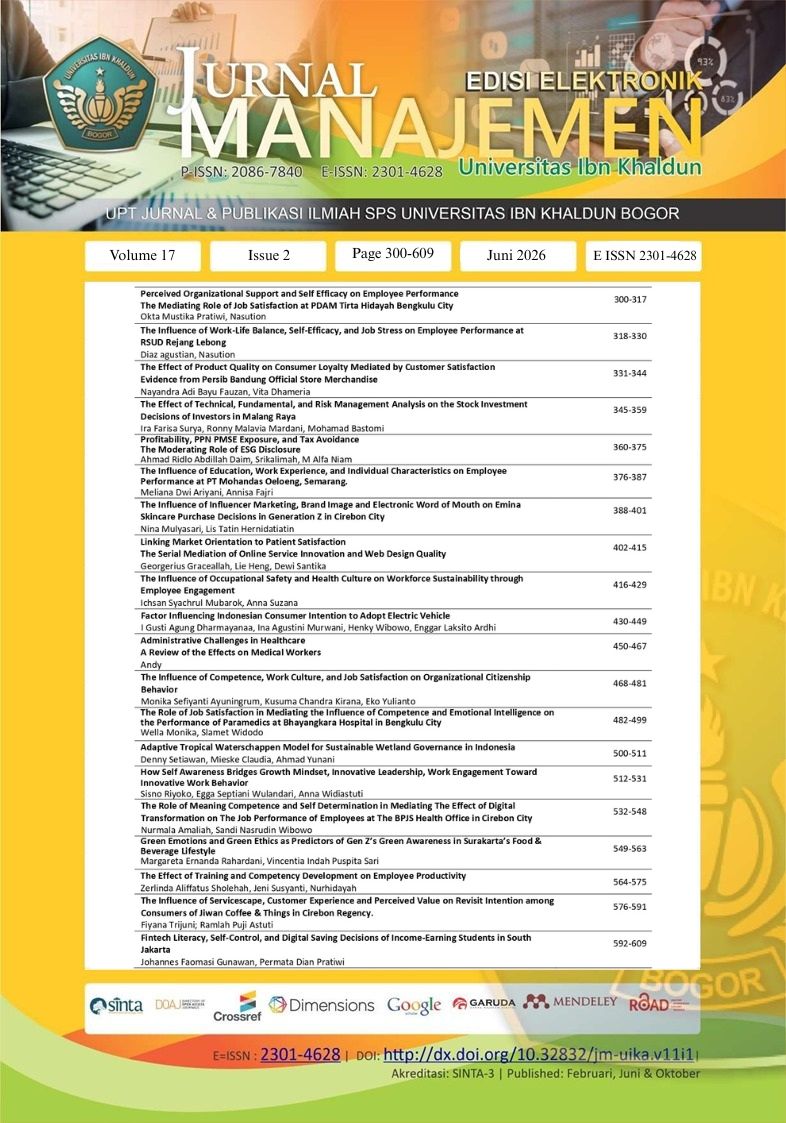
Adaptive Tropical Waterschappen Model for Sustainable Wetland Governance in Indonesia
DOI:
https://doi.org/10.32832/jm-uika.v17i2.23488Keywords:
wetland governance; tropical waterschappen; human capital; institutional behavior; adaptive governanceAbstract
Wetlands in Indonesia play a strategic role in food security, water regulation, carbon storage, and local livelihoods, yet their governance remains constrained by fragmented institutions, weak infrastructure maintenance, limited participation, and ecological degradation. This article aims to develop an adaptive governance model for sustainable wetland governance in Indonesia by translating selected principles of the Dutch Waterschappen system into tropical wetland settings. The study applies a qualitative descriptive-comparative conceptual design based on literature review, policy review, and illustrative analysis of five Indonesian wetland contexts. The findings identify four recurring governance problems: hydrological–administrative misalignment, weak institutional continuity, limited participatory integration, and low implementation capacity. In response, the article proposes the Tropical Waterschappen model, consisting of six pillars: hydrology-based institutional alignment, inclusive multi-stakeholder governance, collaborative and sustainable financing, adaptive spatial and ecological management, transparent information and participatory monitoring, and implementation capacity through human capital and institutional behavior. The model contributes to wetland governance literature by linking institutional design with an implementation mechanism grounded in human capital and behavioral readiness. Practically, it offers a management-oriented framework for strengthening coordination, participation, financing continuity, and adaptive ecological governance in Indonesian wetlands.
References
Adeyemi, A. E., Ahn, J., Xu, Z., Muko, H., & Matt, B. (2025). Promoting SDGs Through Education: A Theory of Planned Behavior Analysis of Japanese and Nigerian Students’ Sustainability Actions. Sustainable Development, 33, 6901–6916. https://doi.org/10.1002/sd.3493
Ajzen, I. (1991). The Theory of Planned Behavior. Organizational Behavior and Human Decision Processes, 50(2), 179–211. https://doi.org/10.1016/0749-5978(91)90020-T
Ajzen, I. (2020). The Theory of Planned Behavior: Frequently Asked Questions. Human Behavior and Emerging Technologies, 2(4), 1–11. https://doi.org/10.1002/hbe2.195
Cantaluppi, M. G., Marchi, M. De, Pace, M., & Tosi, M. C. (2023). Wetland Contracts as Sustainable Governance Tools: A Review of the Output of the Interreg Project CREW “Coordinated Wetland Management in Italy-Croatia Cross Border Region.” Sustainability, 15(6491), 1–18. https://doi.org/10.3390/su15086491
Kabat, P., Fresco, L. O., Stive, M. J. F., Veerman, C. P., Alphen, J. S. L. J. Van, Parmet, B. W. A. H., Hazeleger, W., & Katsman, C. A. (2009). Dutch coasts in transition. Nature Publishing Group, 2(7), 450–452. https://doi.org/10.1038/ngeo572
Lyastini, R., Arman, S., & Sudrajat, J. (2024). Kearifan Lokal Masyarakat Adat Sebaju dalam Pengelolaan Sumber Daya Hutan. Jurnal Teknologi Lahan Basah, 12(3), 749–763. https://doi.org/10.26418/jtllb.v12i3
Novak, A., & Juvan, L. (2025). What Affects Farmers’ Intention to Learn About Sustainability in Online Settings? An Application of the Extended Theory of Planned Behaviour in Slovenia ˇ. Jurnal of Rural Studies, 114. https://doi.org/10.1016/j.jrurstud.2024.103548
Pahl-Wostl, C. (2009). A Conceptual Framework for Analysing Adaptive Capacity and Multi-level Learning Processes in Resource Governance Regimes. Global Environmental Change, 19(3), 354–365. https://doi.org/10.1016/j.gloenvcha.2009.06.001
Parker, Q. M., Tsimijaly, H., Long, S., & Jones, P. J. S. (2024). A longitudinal Governance Analysis of A locally Managed Marine Area: Ankobohobo Wetland Small-scale Mud Crab Fishery, Madagascar. Marine Policy, 163(April). https://doi.org/10.1016/j.marpol.2024.106138
Qodriyatun, S. N. (2017). Kesiapan Pemerintah Daerah Provinsi Riau dan Sumatera Selatan dalam Pelaksanaan Kebijakan Restorasi Gambut. Jurnal Aspirasi: Jurnal Masalah Masalah Sosial, Vol 8, No 2 (2017), 113–132. https://doi.org/10.46807/aspirasi.v8i2.1260
Ramsar Convention Secretariat. (2021). Global Wetland Outlook: Special Edition 2021. Ramsar Convention Secretariat. https://www.ramsar.org/document/global-wetland-outlook-special-edition-2021
Runhaar, H., Driessen, P., & others. (2015). Implementation Challenges in Water Policy Integration. Journal of Environmental Policy & Planning, 17(5), 647–663. https://doi.org/10.1080/1523908X.2014.919500
Rusadi, S., & Yuslaini, N. (2021). Prinsip Good Environmental Governance oleh Pemerintah Kabupaten Siak ( Studi Kasus Kebakaran Lahan Gambut Di Kecamatan Dayun ). Jurnal Niara, 14(2), 135–141. https://doi.org/10.31849/niara.v14i2.5502
Susilawati, A., Wahyudi, E., Minsyah, N., Selatan, K., Lima, P., & Baru, K. (2017). Pengembangan Teknologi untuk Pengelolaan Lahan Rawa Pasang Surut Berkelanjutan. Jurnal Lahan Suboptimal: Journal of Suboptimal Lands, 6(1), 87–94. https://doi.org/10.33230/JLSO.6.1.2017.295
Yusran, A. (2022). Fragmentasi Kelembagaan dalam Pengelolaan Ekoregion Lahan Basah. Borneo Governance Review, 4(1). https://ojs.ulm.ac.id/index.php/BGR/article/view/11832
Downloads
Published
How to Cite
Issue
Section
License
Copyright (c) 2026 Jurnal Manajemen

This work is licensed under a Creative Commons Attribution-NonCommercial 4.0 International License.
Authors who publish with this journal agree to the following terms:
- Authors retain copyright and grant the journal right of first publication with the work simultaneously licensed under a Creative Commons Attribution-NonCommercial-ShareAlike 4.0 International License that allows others to share the work with an acknowledgement of the work's authorship and initial publication in this journal.
- Authors can enter into separate, additional contractual arrangements for the non-exclusive distribution of the journal's published version of the work (e.g., post it to an institutional repository or publish it in a book), with an acknowledgement of its initial publication in this journal.
- Authors are permitted and encouraged to post their work online (e.g., in institutional repositories or on their website) prior to and during the submission process, as it can lead to productive exchanges, as well as earlier and greater citation of published work (See The Effect of Open Access).